Summer Certification Limited Time 70% Discount Offer - Ends in 0d 00h 00m 00s - Coupon code = getmirror

Pass the Amazon Web Services AWS Certified Specialty SCS-C03 Questions and answers with ExamsMirror

Practice at least 50% of the questions to maximize your chances of passing.
Exam SCS-C03 Premium Access

View all detail and faqs for the SCS-C03 exam


563 Students Passed

90% Average Score

92% Same Questions
Viewing page 1 out of 7 pages
Viewing questions 1-10 out of questions
Questions # 1:

A company runs an application on a fleet of Amazon EC2 instances. The company can remove instances from the fleet without risk to the application. All EC2 instances use the same security group named ProdFleet. Amazon GuardDuty and AWS Config are active in the company ' s AWS account.

A security engineer needs to provide a solution that will prevent an EC2 instance from sending outbound traffic if GuardDuty generates a cryptocurrency finding event. The security engineer creates a new security group named Isolate that contains no outbound rules. The security engineer configures an AWS Lambda function to remove an EC2 instance from the ProdFleet security group and add it to the Isolate security group.

Which additional step will meet this requirement?

Options:

A.

Configure GuardDuty to directly invoke the Lambda function if GuardDuty generates a CryptoCurrency:EC2/* finding event.

B.

Configure an AWS Config rule that invokes the Lambda function if a CryptoCurrency:EC2/* configuration change event occurs for an EC2 instance.

C.

Configure an Amazon EventBridge rule that invokes the Lambda function if GuardDuty generates a CryptoCurrency:EC2/* finding event.

D.

Configure an Amazon EventBridge rule that invokes the Lambda function if AWS Config detects a CryptoCurrency:EC2/* configuration change event for an EC2 instance.

Questions # 2:

A company wants to implement a content delivery network (CDN) for an upcoming product launch. The origin for distribution is a web server outside the AWS Cloud. The origin requires an authorization header from each request.

Which solution will meet these requirements?

Options:

A.

Use AWS Global Accelerator to create a custom routing accelerator. Configure the accelerator to use TCP. Specify the web server’s IP address. Include the required authorization header in the request. Configure the web server to respond to requests from authorized users by using a signed cookie in the response header.

B.

Create an Amazon CloudFront distribution. Configure CloudFront to use an origin access control (OAC). Specify the web server as the origin. Include the required authorization header in the OAC request. Configure the web server to respond to requests from authorized users by using a signed URL.

C.

Create an Amazon CloudFront distribution. Configure CloudFront to forward a custom header to the origin. Specify trusted key groups for the distribution. Configure the web server to respond to requests from authorized users by using a signed URL.

D.

Use AWS Global Accelerator to create an origin access control (OAC). Specify the web server as the origin. Include a custom header in the request. Configure the web server to respond to requests from authorized users by using a signed cookie in the response header.

Questions # 3:

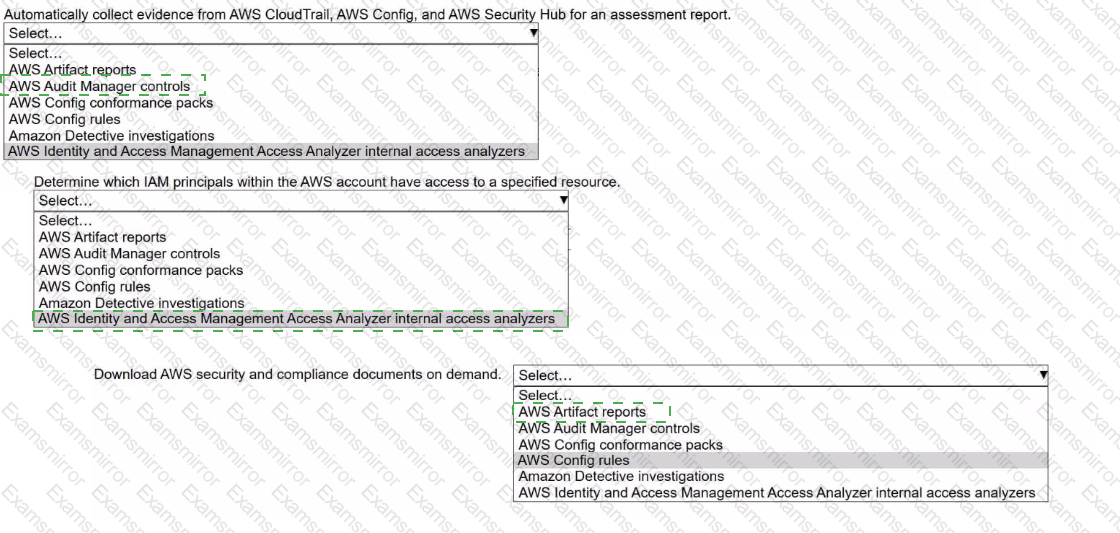
A security engineer needs to prepare for a security audit of an AWS account.

Select the correct AWS resource from the following list to meet each requirement. Select each resource one time or not at all. (Select THREE.)

• AWS Artifact reports

• AWS Audit Manager controls

• AWS Config conformance packs

• AWS Config rules

• Amazon Detective investigations

• AWS Identity and Access Management Access Analyzer internal access analyzers
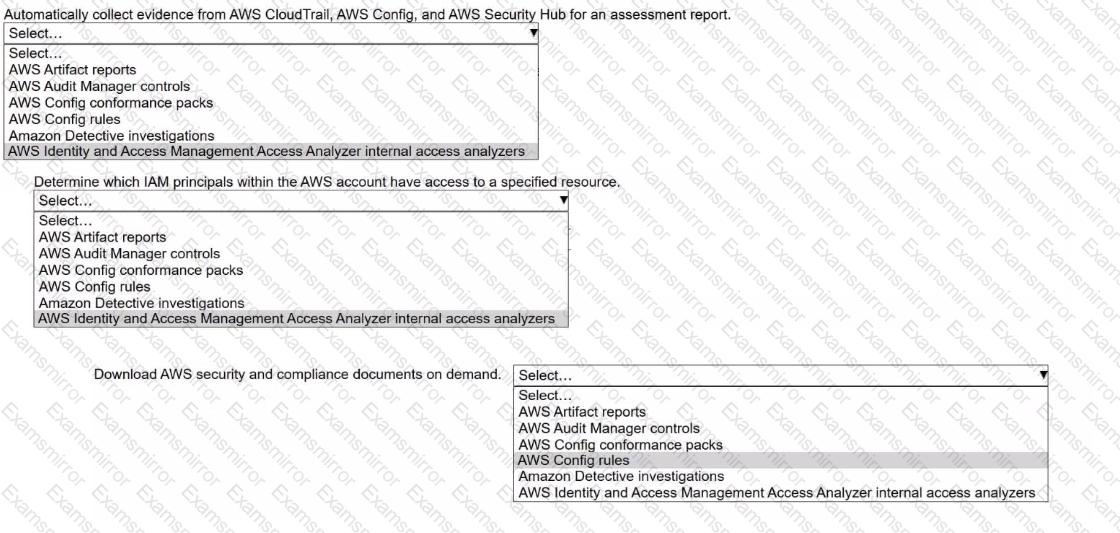
Question # 3

Options:

Questions # 4:

A company has a platform that is divided into 12 AWS accounts under the same organization in AWS Organizations. Many of these accounts use Amazon API Gateway to expose APIs to the company ' s frontend applications. The company needs to protect the existing APIs and any resources that will be deployed in the future against common SQL injection and bot attacks.

Which solution will meet these requirements with the LEAST operational overhead?

Options:

A.

Create an AWS WAF web ACL for each API. Include managed rules to block SQL injection and bot attacks. Use AWS Config to detect new resources that do not have a web ACL. Configure a remediation action to provision a web ACL for these resources.

B.

Use AWS Firewall Manager to create an AWS WAF policy. Configure the policy to include the AWS Bot Control and SQL database managed rule groups. Set the policy scope to include the API Gateway stage as the resource type.

C.

Create an AWS Service Catalog product for an AWS WAF web ACL that includes rules to block SQL injection and bot attacks. Use AWS Config to detect new resources that do not have this product applied. Configure a remediation action to provision a web ACL for these resources.

D.

Use AWS Security Hub to detect unprotected resources and to send the findings as custom action events to Amazon EventBridge. Create an AWS Lambda function for these events to provision an AWS WAF web ACL for the unprotected resources. Include managed rules to block SQL injection and bot attacks.

Questions # 5:

A company uses AWS Organizations and has an SCP at the root that prevents sharing resources with external accounts. The company now needs to allow only the marketing account to share resources externally while preventing all other accounts from doing so. All accounts are in the same OU.

Which solution will meet these requirements?

Options:

A.

Create a new SCP in the marketing account to explicitly allow sharing.

B.

Edit the existing SCP to add a condition that excludes the marketing account.

C.

Edit the SCP to include an Allow statement for the marketing account.

D.

Use a permissions boundary in the marketing account.

Questions # 6:

A company has a compliance requirement to encrypt all data in transit. The company recently discovered an Amazon Aurora cluster that does not meet this requirement.

How can the company enforce encryption for all connections to the Aurora cluster?

Options:

A.

In the Aurora cluster configuration, set therequire_secure_transportDB cluster parameter toON.

B.

Use AWS Directory Service for Microsoft Active Directory to create a user directory and to enforce Kerberos authentication with Aurora.

C.

Configure the Aurora cluster to use AWS Certificate Manager (ACM) to provide encryption certificates.

D.

Create an Amazon RDS proxy. Connect the proxy to the Aurora cluster to enable encryption.

Questions # 7:

A company’s application team needs a new AWS Key Management Service (AWS KMS) customer managed key to use with Amazon S3. The company’s security policy requires separate keys for different AWS services to limit security exposure.

How can a security engineer limit the KMS customer managed key to work with only Amazon S3?

Options:

A.

Configure the key policy to allow only Amazon S3 to perform the kms:Encrypt action.

B.

Configure the key policy to allow KMS actions only when the value for the kms:ViaService condition key matches the Amazon S3 service name.

C.

Configure the application’s IAM role policy to allow Amazon S3 to perform the iam:PassRole action.

D.

Configure the application’s IAM role policy to allow only S3 operations when the operations are combined with the KMS customer managed key.

Questions # 8:

A security administrator is setting up a new AWS account. The security administrator wants to secure the data that a company stores in an Amazon S3 bucket. The security administrator also wants to reduce the chance of unintended data exposure and the potential for misconfiguration of objects that are in the S3 bucket.

Which solution will meet these requirements with the LEAST operational overhead?

Options:

A.

Configure the S3 Block Public Access feature for the AWS account.

B.

Configure the S3 Block Public Access feature for all objects that are in the bucket.

C.

Deactivate ACLs for objects that are in the bucket.

D.

Use AWS PrivateLink for Amazon S3 to access the bucket.

Questions # 9:

A company needs to implement DNS Security Extensions (DNSSEC) for a specific subdomain. The subdomain is already registered with Amazon Route 53. A security engineer has enabled DNSSEC signing and has created a key-signing key (KSK). When the security engineer tries to test the configuration, the security engineer receives an error for a broken trust chain.

What should the security engineer do to resolve this error?

Options:

A.

Replace the KSK with a zone-signing key (ZSK).

B.

Deactivate and then activate the KSK.

C.

Create a Delegation Signer (DS) record in the parent hosted zone.

D.

Create a Delegation Signer (DS) record in the subdomain.

Questions # 10:

A company is running an application in the eu-west-1 Region. The application uses an AWS Key Management Service (AWS KMS) customer managed key to encrypt sensitive data. The company plans to deploy the application in the eu-north-1 Region. A security engineer needs to implement a key management solution for the application deployment in the new Region. The security engineer must minimize changes to the application code.

Which change should the security engineer make to the AWS KMS configuration to meet these requirements?

Options:

A.

Update the key policies in eu-west-1. Point the application in eu-north-1 to use the same customer managed key as the application in eu-west-1.

B.

Allocate a new customer managed key to eu-north-1 to be used by the application that is deployed in that Region.

C.

Allocate a new customer managed key to eu-north-1. Create the same alias name for both keys. Configure the application deployment to use the key alias.

D.

Allocate a new customer managed key to eu-north-1. Create an alias for eu--1. Change the application code to point to the alias for eu--1.

Viewing page 1 out of 7 pages
Viewing questions 1-10 out of questions
TOP CODES

TOP CODES

Top selling exam codes in the certification world, popular, in demand and updated to help you pass on the first try.