Summer Certification Limited Time 70% Discount Offer - Ends in 0d 00h 00m 00s - Coupon code = getmirror

Pass the Cisco CCDE v3.0 400-007 Questions and answers with ExamsMirror

Practice at least 50% of the questions to maximize your chances of passing.
Exam 400-007 Premium Access

View all detail and faqs for the 400-007 exam


778 Students Passed

88% Average Score

90% Same Questions
Viewing page 1 out of 11 pages
Viewing questions 1-15 out of questions
Questions # 1:

Company XYZ has two routing domains (EIGRP and OSPF). They want full reachability and need OSPF to see link costs added to external routes. How must redistribution be designed?

Options:

A.

Redistribute using metric type 2 into OSPF.

B.

Redistribute using metric type 1 into OSPF.

C.

Redistribute using metric type 1 into EIGRP.

D.

Redistribute using metric type 2 into EIGRP.

Questions # 2:

Which undesired effect of increasing the jitter compensation buffer is true?

Options:

A.

The overall transport jitter decreases and quality improves.

B.

The overall transport jitter increases and quality issues can occur.

C.

The overall transport delay increases and quality issues can occur.

D.

The overall transport delay decreases and quality improves.

Questions # 3:

Company XYZ has implemented policy-based routing in their network. Which potential problem must be kept in mind about network reconvergence and PBR?

Options:

A.

It can limit network scalability

B.

It can create microloops during reconvergence

C.

It increases convergence time.

D.

It reduces convergence time.

Questions # 4:

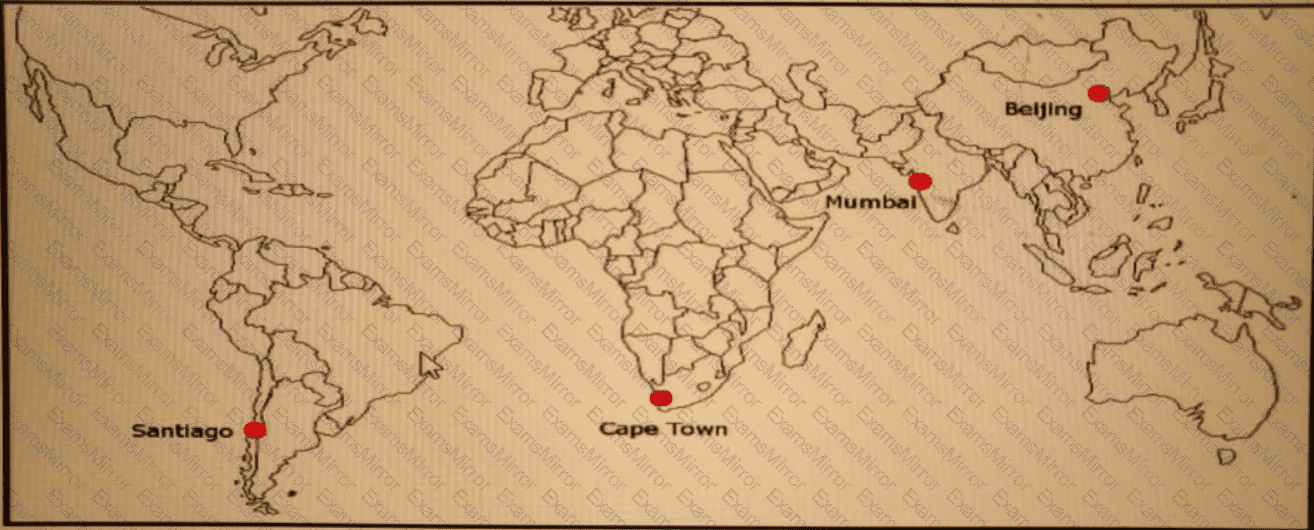
Refer to the exhibit.

Question # 4

ACME Mining has four data centers in Santiago. Cape Town. Mumbai, and Beijing, full-mesh connected via a 400 Mb/s EVP-LAN They want to deploy a new mission-critical application with these

requirements:

    clusterheartbeat2Mb/s continuous (250 KB/s)

    cluster heartbeat one-way maximum latency 100 ms

These are the current ping tests results between the four data centers:
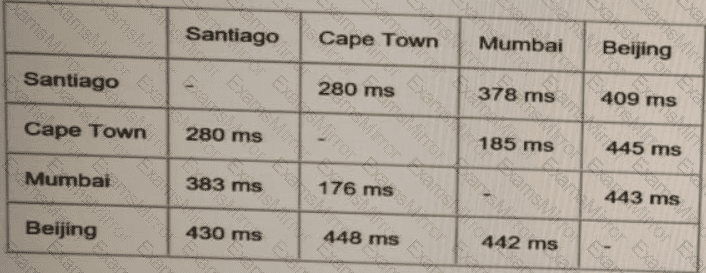
Question # 4

Which hosting data center pair can host the new application?

Options:

A.

Mumbai and Beijing

B.

Santiago and Cape Town

C.

Santiago and Mumbai

D.

Cape Town and Mumbai

E.

Cape Town and Beijing

F.

Santiago and Beijing

Questions # 5:

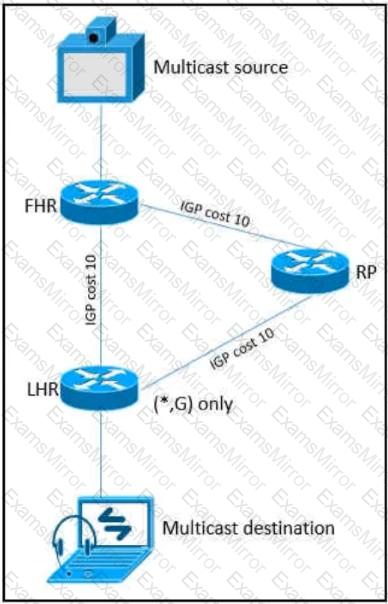
Refer to the exhibit.

Question # 5

As part of a redesign project, you must predict multicast behavior. What happens to the multicast traffic received on the shared tree (*,G), if it is received on the LHR interface indicated?

Options:

A.

It is dropped due to an unsuccessful RPF check against the multicast source

B.

It is switched given that no RPF check is performed

C.

It is switched due to a successful RPF check against the routing table

D.

It is dropped due to an unsuccessful RPF check against the multicast receiver.

Questions # 6:

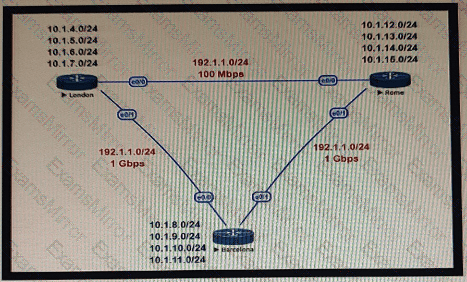
Refer to the exhibit.

Question # 6

This network is running OSPF as the routing protocol. The internal networks are being advertised in OSPF. London and Rome are using the direct link to reach each other although the transfer rates are better via Barcelona. Which OSPF design change allows OSPF to calculate the proper costs?

Options:

A.

Change the OSPF reference bandwidth to accommodate faster links.

B.

Filter the routes on the link between London and Rome.

C.

Change the interface bandwidth on all the links.

D.

Implement OSPF summarization to fix the issue.

Questions # 7:

As part of a new network design documentation, you are required to explain the reason for choosing Cisco FabricPath for Layer 2 loop avoidance.

Which two elements help Cisco FabricPath mitigate Layer 2 loops if they happen in the Layer 2 MP network? (Choose two)

Options:

A.

MAC tunneling

B.

IS-IS multipath

C.

RPF check

D.

TTL header

Questions # 8:

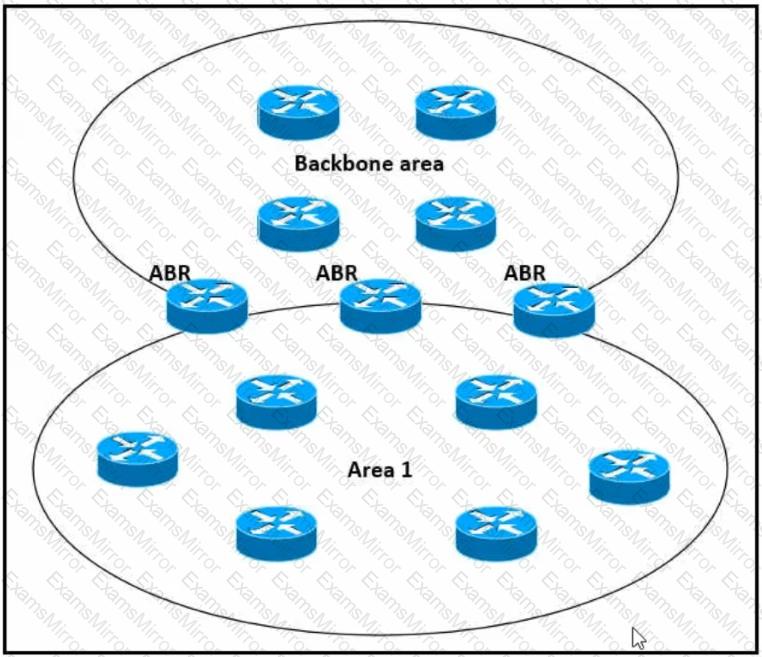
Refer to the exhibit.

Question # 8

Which impact of using three or more ABRs between the backbone area and area 1 is true?

Options:

A.

In a large-scale network LSA replication by all ABRs can cause serious scalability issues

B.

Multiple ABRs reduce the CPU processing on each ABR due to splitting prefix advertisement

C.

In a large-scale network multiple ABRs can create microloops

D.

Prefixes from the non-backbone area are advertised by one ABR to the backbone

Questions # 9:

Various teams in different organizations within an enterprise are preparing low-level design documents using a Waterfall project model. Input from relevant stakeholders was captured at the start of the project, and the scope has been defined. What impact will it have if stakeholders ask for changes before documentation is complete?

Options:

A.

This provides more opportunity to think outside the box.

B.

Rework is expected before the delivery.

C.

Significant effort and time are required.

D.

This provides a flexible approach to incorporate changes.

Questions # 10:

You are designing the QoS policy for a company that is running many TCP-based applications. The company is experiencing tail drops for these applications. The company wants to use a congestion avoidance technique for these applications. Which QoS strategy can be used?

Options:

A.

Weighted fair queuing

B.

Weighted random early detection

C.

Low-latency queuing

D.

First-in first-out

Questions # 11:

Which two statements describe the usage of the IS-IS overload bit technique? (Choose two.)

Options:

A.

If overload-bit is set on a Level 2 intermediate system, the other Level 2 intermediate systems in the topology will stop using the overloaded IS to forward Level 2 traffic. However, the intermediate system can still forward Level 1 traffic.

B.

It can be set in intermediate systems (IS-IS routers) to prioritize control plane CSNP packets.

C.

It can be used to automatically synchronize the link-state database between Level 1 intermediate systems.

D.

It can be set in intermediate systems (IS-IS routers) to avoid traffic black holes until routing protocols are fully converged after a reload operation.

E.

It can be set in intermediate systems (IS-IS routers) to attract transit traffic from other intermediate systems.

Questions # 12:

Hybrid cloud computing allows organizations to take advantage of public and private cloud models. Which best practice should organizations follow to ensure data security in the private cloud?

Options:

A.

Use standard protocols for data transmission over the network.

B.

Encrypt data when it is at rest and in motion.

C.

Communicate all data security risks to customers and end users.

D.

Use standard network protocols for data communication between unsecured network connections.

Questions # 13:

A large enterprise cloud design team is evaluating cloud consumption models. What is an example of a typical PaaS limitation or concern?

Options:

A.

Vendor lock-in

B.

Runtime issues

C.

Lack of control

D.

Multi-tenant security

Questions # 14:

Which two descriptions of CWDM are true? (Choose two)

Options:

A.

Typically used over long distances, but requires optical amplification

B.

Uses the 850nm band

C.

Allows up to 32 optical carriers to be multiplexed onto a single fiber

D.

Shares the same transmission window as DWDM

E.

Passive CWDM devices require no electrical power

Questions # 15:

As network designer, which option is your main concern with regards to virtualizing multiple network zones into a single hardware device?

Options:

A.

Fate sharing

B.

CPU resource allocation

C.

Congestion control

D.

Security

E.

Bandwidth allocation

Viewing page 1 out of 11 pages
Viewing questions 1-15 out of questions
TOP CODES

TOP CODES

Top selling exam codes in the certification world, popular, in demand and updated to help you pass on the first try.