
Summer Certification Limited Time 70% Discount Offer - Ends in 0d 00h 00m 00s - Coupon code = getmirror

Pass the Anthropic Claude Certified Architect CCAR-P Questions and answers with ExamsMirror

Practice at least 50% of the questions to maximize your chances of passing.
Exam CCAR-P Premium Access

View all detail and faqs for the CCAR-P exam


0 Students Passed

0% Average Score

0% Same Questions
Viewing page 2 out of 4 pages
Viewing questions 11-20 out of questions
Questions # 11:

You are auditing a procurement-assistant agent whose defined responsibility is to draft purchase requests for review.

For each tool currently configured on the agent, select yes if the tool should remain after a least-privilege audit. Otherwise, select no if it should be removed.
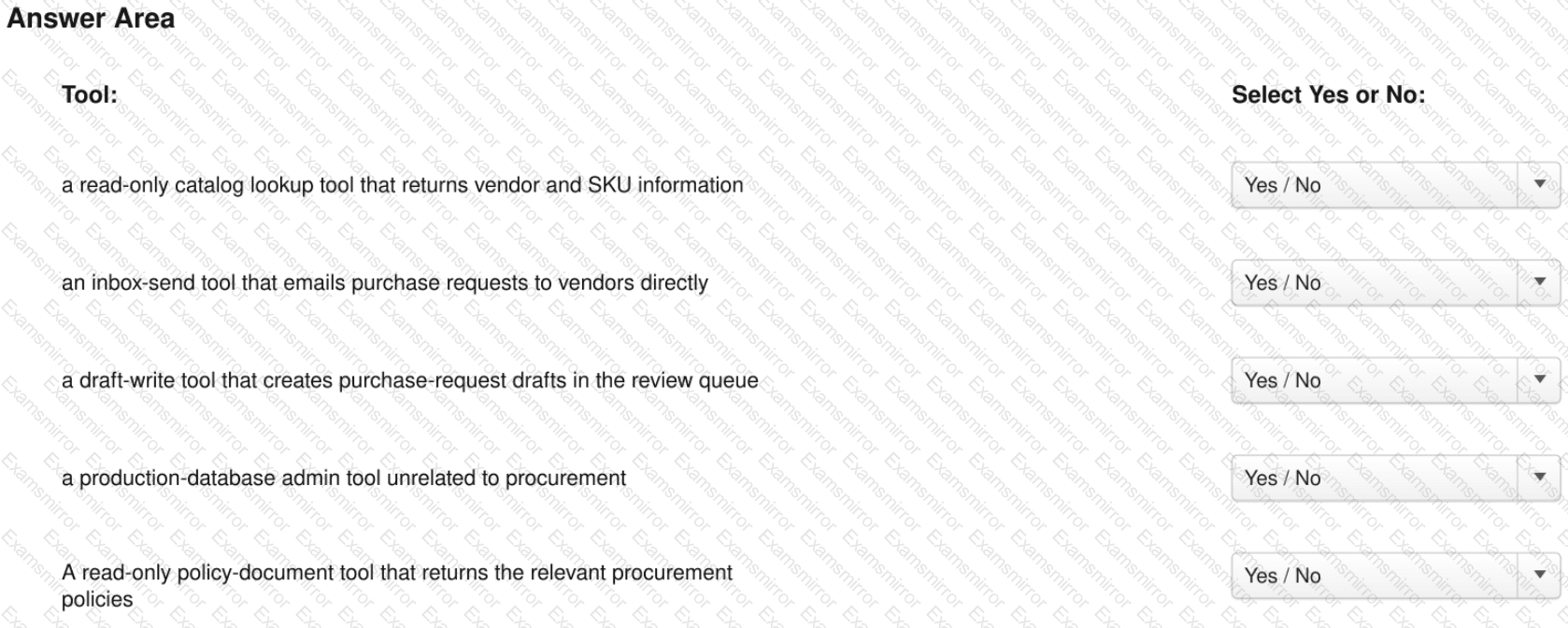
Question # 11

Options:

Questions # 12:

You are compiling factors that should drive the choice between Model Context Protocol (MCP), direct API integration, and agent-to-agent handoff.

Which two factors belong on the list? (Select two.)

Each correct answer presents a complete solution.

Options:

A.

Whether the vendor publishes detailed reference documentation for each candidate protocol.

B.

Whether the team has prior implementation experience with any of the candidate protocols.

C.

Whether the underlying transport supports encryption in transit between the integrated services.

D.

Whether the integration must be portable across multiple AI clients in the ecosystem.

E.

Whether the interaction is stateless and latency-sensitive or stateful and longer-running.

Questions # 13:

You are a solution architect designing a Claude-based assistant with access to 60 internal tools across multiple business domains. Loading every tool definition on every request increases token usage and time to first response.

Which design pattern best addresses this issue without sacrificing capability breadth?

Options:

A.

Apply progressive tool discovery so a curated initial subset is exposed and additional tools are loaded on demand based on the task.

B.

Use a separate model call to summarize all 60 tool definitions before each user turn.

C.

Increase the maximum context length and load all 60 tool definitions on every request, accepting the higher token cost and latency as necessary for full capability.

D.

Hard-code a fixed set of five tools per request to reduce token usage, regardless of whether those tools are relevant to the current task.

Questions # 14:

You are building an ethics-review checklist for deployments supported by artificial intelligence.

Which two checks belong on the list? (Select two.)

Each correct answer presents a complete solution.

Options:

A.

Confirm that vendor licensing terms permit the planned production use of the model.

B.

Verify that outputs do not rely on generalizations about people that the underlying data does not support.

C.

Confirm that high-impact decisions retain human accountability rather than being attributed to the model.

D.

Restrict ethics review to outputs that exceed a defined model-confidence threshold.

E.

Confirm that latency and throughput targets are met across supported user populations.

Questions # 15:

A Claude architect is implementing safety controls for a customer-facing advice assistant that must never provide regulated investment recommendations.

Which two guardrail implementations most directly enforce this constraint? (Select two.)

Options:

A.

Increase response temperature to introduce variability that reduces the likelihood of specific recommendations.

B.

Add an output classifier that detects and blocks responses containing regulated investment-recommendation language.

C.

Limit session length to reduce the volume of queries processed per user per day.

D.

Log all user queries to a SIEM for post-hoc compliance review.

E.

Define explicit out-of-scope categories in the system prompt with fixed refusal phrasing for investment advice requests.

Questions # 16:

A technical team is cataloguing risks specific to Claude’s use in a document-grounded Q & A system.

Which two items represent failure modes intrinsic to LLM-based systems rather than generic software defects? (Select two.)

Options:

A.

An expired TLS certificate blocks outbound API calls to Claude.

B.

A database connection timeout causes retrieval to return an empty result set.

C.

The model refuses a legitimate query because surface features trigger an overly broad safety pattern.

D.

A misconfigured load balancer routes requests to a deprecated API version.

E.

The model generates a plausible-sounding answer unsupported by any retrieved document.

Questions # 17:

You are designing a content moderation classifier that processes high volumes of user-generated comments under a tight per-message latency budget using well-defined classification labels.

Which model selection best aligns with the workload?

Options:

A.

Opus, because every moderation decision requires maximum reasoning depth regardless of classification complexity.

B.

Haiku, because its latency and cost profile align with high-volume classification workloads that require limited reasoning depth.

C.

Sonnet, because larger general-purpose models are preferred even when workload latency requirements are strict.

D.

Sonnet with extended thinking enabled, because deeper reasoning should be applied to every moderation request to improve edge-case handling.

Questions # 18:

You are identifying the highest-impact optimization for a deployment whose token cost is dominated by a long, repeated system prompt and a large retrieved context per request.

Which optimization most directly targets the dominant cost driver?

Options:

A.

Increase retrieval depth on every request to maximize recall, worsening the dominant cost driver by adding more retrieved tokens per request rather than reducing them.

B.

Add additional repeated content to the system prompt to give the model more guidance.

C.

Move the long, repeated system prompt into a cacheable prefix and trim retrieved context to the spans relevant to each query.

D.

Switch every request to the heaviest available model to maximize output quality, accepting that higher per-request inference cost compounds rather than addresses the dominant cost driver.

Questions # 19:

You are supporting an engineer whose newly added MCP server does not appear in their Claude Code session.

Which diagnostic step should be tried first?

Options:

A.

Disable every MCP server in the configuration to isolate the issue, removing all tool access rather than confirming whether the new server is registered.

B.

Switch the team to a different Claude product family unrelated to the existing workflow, abandoning the current configuration rather than diagnosing the registration issue.

C.

Verify the MCP server is registered using the listing command, then reconnect the session if needed, since configuration changes typically require a restart to take effect.

D.

Reinstall the developer’s operating system from scratch, discarding all local configuration and tool state before attempting any targeted diagnostic steps.

Questions # 20:

A Claude architect needs to ensure that a security-hardening flag cannot be disabled by any individual engineer after it is set.

Which configuration scope correctly enforces this requirement?

Options:

A.

User scope (~/.claude/settings.json) on each engineer’s machine

B.

Environment variable defined in the CI/CD pipeline only

C.

Managed configuration applied centrally and marked as non-overridable

D.

Project scope (.claude/settings.json) committed to the repository

Viewing page 2 out of 4 pages
Viewing questions 11-20 out of questions
TOP CODES

TOP CODES

Top selling exam codes in the certification world, popular, in demand and updated to help you pass on the first try.