
Pre-Summer Special Limited Time 70% Discount Offer - Ends in 0d 00h 00m 00s - Coupon code = getmirror

Pass the APICS Supply Chain Professional CSCP Questions and answers with ExamsMirror

Practice at least 50% of the questions to maximize your chances of passing.
Exam CSCP Premium Access

View all detail and faqs for the CSCP exam


747 Students Passed

87% Average Score

96% Same Questions
Viewing page 13 out of 13 pages
Viewing questions 181-195 out of questions
Questions # 181:

The value that logistics provides within the supply chain can best be summarized as:

Options:

A.

satisfying customer expectations about availability and delivery at an acceptable total cost.

B.

meeting promised location and on-time delivery goals with minimal use of expediting.

C.

establishing inventory and delivery goals with various customers that fulfill the firm's profit objectives.

D.

providing accurate in-transit and delivery information to customers and salespeople.

Questions # 182:

The question below is based on the following flowchart:
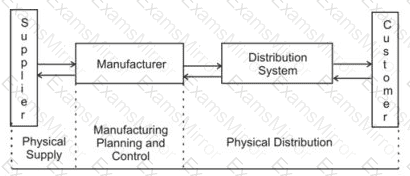
Question # 182

Which of the following phrases most accurately describes the complete flow of demand information?

Options:

A.

From supplier to customer

B.

From customer to manufacturer

C.

From customer to supplier

D.

From supplier to manufacturer

Questions # 183:

The factors to consider in the make-or-buy decision include costs, proprietary knowledge, and:

Options:

A.

design history.

B.

available capacity.

C.

inventory balance.

D.

warehouse location.

Questions # 184:

A media company offers a majority of its movies through a specific distributor. The media company is beginning to produce content for a new foreign market to which the distributor has exclusive access. To maximize savings and gain entry to this new market, the media company should:

Options:

A.

create a contract for the new market.

B.

enter into a partnership.

C.

form a strategic alliance.

D.

acquire the distributor.

Questions # 185:

A manufacturer can simplify the forecasting process by pooling demand forecasts for a product group and then:

Options:

A.

averaging total demand and spreading it evenly across all items.

B.

disaggregating demand to the item level based on marketing input.

C.

disaggregating demand to the item level based on historical proportions.

D.

allocating demand to each production site.

Questions # 186:

Which of the following actions typically would be considered part of a reverse logistics strategy?

Options:

A.

Offering a discount on new purchases when used products are returned

B.

Reducing the amount of packaging material used in shipping

C.

Manufacturing products in batches consistent with full-truckload shipments

D.

Batching returns of defective components to the suppliers

Questions # 187:

Which of the following strategies is used primarily for demand planning?

Options:

A.

Build-to-order scheduling

B.

Push-pull replenishment

C.

Collaborative planning, forecasting, and replenishment

D.

Vendor-managed inventory

Questions # 188:

Compared to a global strategy, a multicountry strategy would be characterized by:

Options:

A.

strategy coordination across countries.

B.

preferred suppliers located in host countries.

C.

major strategic decisions coordinated centrally.

D.

products adapted to local needs.

Questions # 189:

A company's annual cost of goods sold is $350 million, and inventory carrying cost is 18%. The company averages four inventory turns. The cost savings resulting from increasing inventory turns from four to six would be:

Options:

A.

$29,000,000.

B.

$15,750,000.

C.

$10,500,000.

D.

$ 5,250,000.

Questions # 190:

Which of the following situations is an example of postponement?

Options:

A.

Shipments are broken down into small groups for reshipment.

B.

Shipments are consolidated immediately for reshipment.

C.

Production begins after a customer order is received.

D.

Partially assembled goods are assembled at a later stage.

Questions # 191:

Which of the following practices has improved management of the customer pipeline?

Options:

A.

Reverse auctions

B.

Sales force automation

C.

Finite capacity planning

D.

Point-of-purchase metrics

Questions # 192:

Which of the following organizational design choices is an example of vertical integration?

Options:

A.

Contracting with a third-party logistics provider

B.

Producing components used internally

C.

Externally staffing a customer service center

D.

Awarding a one-time trade show contract

Questions # 193:

A return material authorization (RMA) policy is used in reverse logistics to:

Options:

A.

physically transport returned items by using an efficient transportation mode.

B.

minimize the number of returned items by involving product design and demand forecasting.

C.

reduce the cost of returned items by refusing to accept items that should not be returned.

D.

reclaim substantial value from returned items by recycling.

Questions # 194:

Which of the following actions typically would be the first step in implementing the philosophy of customer relationship management?

Options:

A.

Creating a customer-centric organization

B.

Developing a map of the customer segments

C.

Documenting the objectives for implementation

D.

Selecting an information technology solution

Questions # 195:

The primary reason for the evolution of the supply chain is:

Options:

A.

fewer rejects due to poor quality.

B.

increased on-time delivery.

C.

increased cost savings.

D.

increased communication.

Viewing page 13 out of 13 pages
Viewing questions 181-195 out of questions
TOP CODES

TOP CODES

Top selling exam codes in the certification world, popular, in demand and updated to help you pass on the first try.