
Pre-Summer Special Limited Time 70% Discount Offer - Ends in 0d 00h 00m 00s - Coupon code = getmirror

Pass the CIW Web Development Series 1D0-541 Questions and answers with ExamsMirror

Practice at least 50% of the questions to maximize your chances of passing.
Exam 1D0-541 Premium Access

View all detail and faqs for the 1D0-541 exam


728 Students Passed

87% Average Score

93% Same Questions
Viewing page 3 out of 4 pages
Viewing questions 21-30 out of questions
Questions # 21:

Which security technique limits access by unauthorized users to parts of an enterprise database?

Options:

A.

Views

B.

Concurrency

C.

Locking

D.

Integrity controls

Questions # 22:

Consider the Information Engineering diagram in the exhibit showing a conceptual data model of the relations BUILDING and RESIDENT. What is the next step in refining the data model?
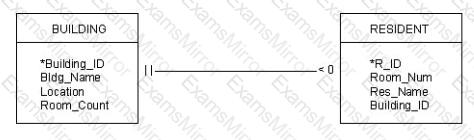
Question # 22

Options:

A.

Create intermediate entities.

B.

Create a logical data model.

C.

Resolve many-to-manyrelationships.

D.

Identify and resolve complex relationships.

Questions # 23:

Which statement best describes a candidate key?

Options:

A.

It is the primary key for an entity.

B.

It uniquely identifies every instance of an entity.

C.

One or more keys are joined together to form a composite key.

D.

One or more keys may be used to form a primary key.

Questions # 24:

Consider the Project relation shown in the exhibit as well as the following SQL statement: Which of the following tables shows the Project relation after execution of this SQL statement?
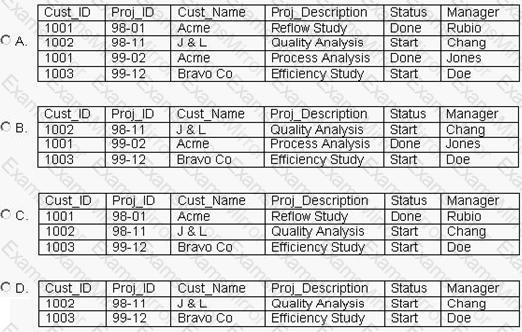
Question # 24

Options:

A.

OptionA

B.

OptionB

C.

OptionC

D.

OptionD

Questions # 25:

Consider the Information Engineering diagram in the exhibit showing the relations BUILDING and RESIDENT. What is the relationship between BUILDING and RESIDENT?
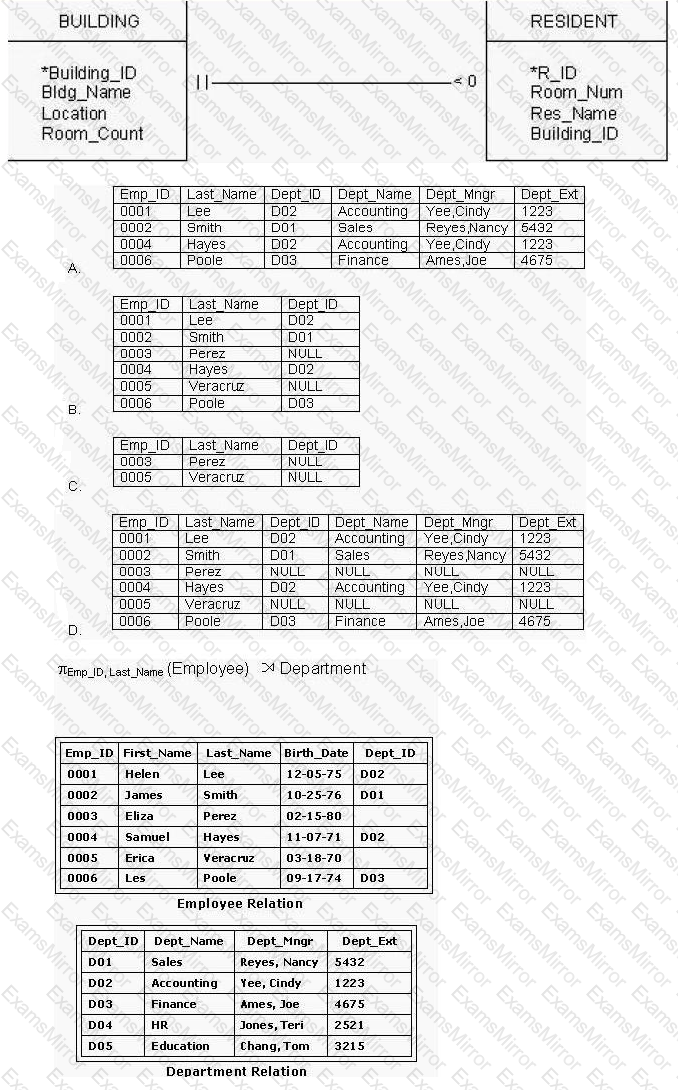
Question # 25

Options:

A.

1:1

B.

1:N

C.

N:1

D.

M:N

Questions # 26:

Which of the following best describes a composite key?

Options:

A.

A composite key is a primary key that consists of the first two attributes of a relation.

B.

A composite key is a primary or foreign key defined by its parent keys.

C.

A composite key is a foreign key that consists of the same attributes as the primary key from a related table.

D.

A composite key is a primary or foreign key that consists of two or more attributes of a relation.

Questions # 27:

Which statement accurately describes a characteristic of attributes?

Options:

A.

The ordering of attributes in a table is significant.

B.

An attribute contains values from multiple domains.

C.

An attribute name can be used only once per table.

D.

An attribute name can be used only once in a relational database system with multiple tables.

Questions # 28:

What is the highest normal form of the relation(s) shown in the exhibit?
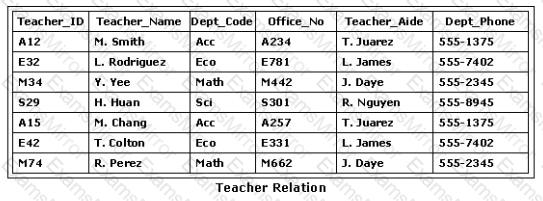
Question # 28

Options:

A.

Boyce-Codd normal form

B.

First normal form

C.

Second normal form

D.

Third normal form

Questions # 29:

What is a data dictionary?

Options:

A.

A system catalog containing user data

B.

An area of the database that is directly accessible by the user

C.

Data that is stored in tables and is only accessible by the DBMS

D.

Metadata that is stored in tables and is only accessible by the DBMS

Questions # 30:

Consider the Dept1_Parts and Dept2_Parts relations shown in the exhibit. Which of the following SQL statements would create an intersection of the two relations with the widest variety of Structured Query Language dialects?
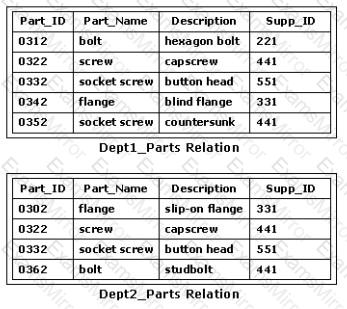
Question # 30

Options:

A.

SELECT *

FROM Dept1_Parts

AND

(SELECT *

FROM Dept2_Parts);

B.

SELECT *

FROM Dept1_Parts

INTERSECTION

(SELECT *

FROM Dept2_Parts);

C.

SELECT *

FROM Dept1_Parts

WHERE Dept1_Parts.Part_ID = Dept2_Parts.Part_ID;

D.

SELECT *

FROM Dept1_Parts

WHERE Dept1_Parts.Part_ID = Dept2_Parts.Part_ID;

Viewing page 3 out of 4 pages
Viewing questions 21-30 out of questions
TOP CODES

TOP CODES

Top selling exam codes in the certification world, popular, in demand and updated to help you pass on the first try.