
Halloween Sale Special Limited Time 75% Discount Offer - Ends in 0d 00h 00m 00s - Coupon code = drift75
Pass the CSI Canadian Securities Course AFP-Exam-1 Questions and answers with ExamsMirror
Exam AFP-Exam-1 Premium Access
View all detail and faqs for the AFP-Exam-1 exam
0 Students Passed
0% Average Score
0% Same Questions
Jackson, a wealth advisor, is helping Terry, a self-employed IT professional, determine his net income. The goal is to develop a budget and savings strategy for the year ahead Terry has provided the information below:
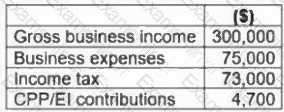
What is Terry’s net business income?
A financial planner, Rachel, is preparing to recommend a discretionary portfolio manager to her client. The portfolio manager is owned by Rachel’s former employer, and Rachel receives no referral fee. However, the former employer regularly sends new clients to Rachel’s practice. What should Rachel do before making the recommendation?
Rosa has just learned that her daughter Marissa, age 23, does not intend to return to university. She has been saving for her daughter's education since Marissa was 10 and is concerned there will be a significant tax liability. How should Rosa's financial planner advise her to utilize the funds when she redeems the RESP in order to offset the tax liability?
A client sends an email alleging that a mutual fund recommendation was unsuitable because the fund declined sharply after purchase. The client asks for compensation. What is the financial planner’s first professional obligation?
A client refuses to provide details about debt balances, tax returns, and monthly expenses but asks the planner to confirm whether retirement at age 55 is achievable. What should the planner do?
A client, age 60, is in a low tax bracket today and expects a larger taxable pension after age 65. She has TFSA and RRSP room. Which contribution priority is generally more appropriate?
Keitaro, age 42, and Ruth, age 52, are married and have two children - Maximo, age 20, and Hannah, age 16, both from Keitaro's previous marriage. In the event Keitaro dies, he would like to minimize taxes, provide for Ruth for the remainder of her life, and then after her death leave the residual to his children. What estate planning strategy should his financial planner recommend to help Keitaro achieve his goal?
Bellamy, a registrant, recently prepared a financial plan for Stewart. As part of the plan, he recommended an asset allocation mutual fund that aligns with Stewart's Know Your Client and suitability. Stewart trusts Bellamy, accepts his recommendations, and is ready to provide purchase instructions. What next step should Bellamy complete in order to implement the strategy?
A couple has stable employment, two dependants, and essential monthly expenses of $5,200. They have no emergency reserve. Which recommendation is most appropriate before increasing long-term investment contributions?
Jonah is meeting with his client, Muhsina, who owns Myke Inc., a Canadian-controlled private corporation. Based on current market value, if he decides to sell Myke Inc., Muhsina will have a capital gain of $400.000. He expects the value of Myke Inc. to increase in future years and has a CNIL balance of $100,000. He wants the future increase in value to be taxed in the hands of his children, Teshi and Kaliyah, and to minimize the cost. What action should Jonah advise Muhsina to take to meet his goal?

TOP CODES
Top selling exam codes in the certification world, popular, in demand and updated to help you pass on the first try.