
Halloween Sale Special Limited Time 75% Discount Offer - Ends in 0d 00h 00m 00s - Coupon code = drift75
Pass the Fortinet Certified Professional Network Security FCSS_EFW_AD-7.6 Questions and answers with ExamsMirror
Exam FCSS_EFW_AD-7.6 Premium Access
View all detail and faqs for the FCSS_EFW_AD-7.6 exam
673 Students Passed
89% Average Score
91% Same Questions
Refer to the exhibit, which shows the ADVPN network topology and partial BGP configuration.


Which two parameters must an administrator configure in the config neighbor range for spokes shown in the exhibit? (Choose two.)
Refer to the exhibit, which shows a hub and spokes deployment.
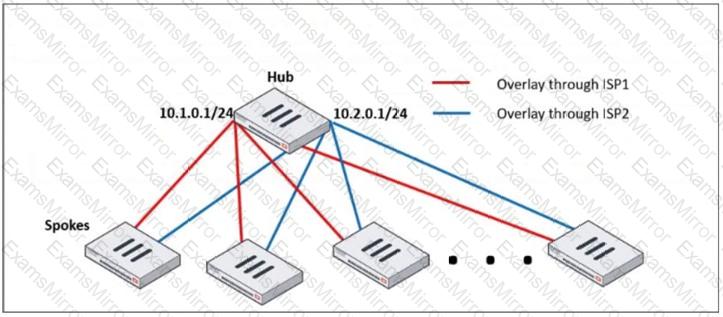
An administrator is deploying several spokes, including the BGP configuration for the spokes to connect to the hub.
Which two commands allow the administrator to minimize the configuration? (Choose two.)
Refer to the exhibit, which shows an ADVPN network

An administrator must configure an ADVPN using IBGP and EBGP to connect overlay network 1 with 2.
What two options must the administrator configure in BGP? (Choose two.)
Which two statements about IKEv2 are true if an administrator decides to implement IKEv2 in the VPN topology? (Choose two.)
Refer to the exhibit, which shows an enterprise network connected to an internet service provider.

An administrator must configure a loopback as a BGP source to connect to the ISP.
Which two commands are required to establish the connection? (Choose two.)
 BGP normally expects directly connected neighbors, but since the ISP and FortiGate A are using loopback interfaces, packets will not be sent directly between their physical interfaces.
 The ebgp-enforce-multihop command allows BGP to form an eBGP peering over multiple hops.
 Since FortiGate is using a loopback interface as the source, the update-source command ensures that BGP updates originate from the loopback interface rather than a physical interface.
 This is essential because BGP peers must match the source IP with the configured neighbor address.
Refer to the exhibit.

The partial output of an OSPF command is shown. You are checking the OSPF status of a FortiGate device when you receive the output shown in the exhibit. Based on the output, which two statements about FortiGate are correct? (Choose two answers)
During the maintenance window, an administrator must sniff all the traffic going through a specific firewall policy, which is handled by NP6 interfaces. The output of the sniffer trace provides just a few packets.
Why is the output of sniffer trace limited?
Refer to the exhibit, which shows a partial troubleshooting command output.

An administrator is extensively using IPsec on FortiGate. Many tunnels show information similar to the output shown in the exhibit.
What can the administrator conclude?
Refer to the exhibit.

A physical topology along with a traffic log is shown. You are using FortiAnalyzer to monitor traffic from the device with IP address 10.0.2.51, which is located behind the FortiGate internal segmentation firewall (ISFW) device. Unified threat management (UTM) is not enabled in the firewall policy on the HQ-ISFW device, and you are surprised to see a log with the action Malware, as shown in the exhibit. What are two reasons why FortiAnalyzer would display this log? (Choose two answers)
Refer to the exhibit.
A pre-run CLI template that is used in zero-touch provisioning (ZTP) and low-touch provisioning (LTP) with FortiManager is shown.

The template is not assigned even though the configuration has already been installed on FortiGate.
What is true about this scenario?

TOP CODES
Top selling exam codes in the certification world, popular, in demand and updated to help you pass on the first try.