
Summer Certification Limited Time 70% Discount Offer - Ends in 0d 00h 00m 00s - Coupon code = getmirror

Pass the HashiCorp Security Automation Certification HCVA0-003 Questions and answers with ExamsMirror

Practice at least 50% of the questions to maximize your chances of passing.
Exam HCVA0-003 Premium Access

View all detail and faqs for the HCVA0-003 exam


775 Students Passed

97% Average Score

95% Same Questions
Viewing page 2 out of 10 pages
Viewing questions 11-20 out of questions
Questions # 11:

How long does the Transit secrets engine store the resulting ciphertext by default?

Options:

A.

24 hours

B.

30 days

C.

32 days

D.

Transit does not store data

Questions # 12:

When generating dynamic credentials, Vault also creates associated metadata, including information like time duration, renewability, and more, and links it to the credentials. What is this referred to as?

Options:

A.

Secret

B.

Token

C.

Lease

D.

Secrets engine

Questions # 13:

Which of the following statements best describes the difference in cluster strategies between self-managed Vault and HashiCorp-managed Vault?

Options:

A.

Self-managed clusters require users to handle setup, maintenance, and scaling, whereas HCP Vault Dedicated is fully managed by HashiCorp and offloads most operational tasks

B.

Neither self-managed clusters nor HCP Vault Dedicated include enterprise security features such as replication or disaster recovery

C.

Both self-managed clusters and HCP Vault Dedicated require manual patching and upgrades, but only self-managed clusters are hosted in the user’s cloud

D.

In self-managed clusters, HashiCorp is responsible for scaling, upgrades, and patching, while HCP Vault Dedicated requires the user to handle all operational overhead

Questions # 14:

Select the policies below that permit you to create a new entry of environment=prod at the path /secrets/apps/my_secret (select three).

Options:

A.

path " secrets/+/my_secret " { capabilities = [ " create " ] allowed_parameters = { " * " = [] } }

B.

path " secrets/apps/my_secret " { capabilities = [ " update " ] }

C.

path " secrets/apps/my_secret " { capabilities = [ " create " ] allowed_parameters = { " environment " = [] } }

D.

path " secrets/apps/* " { capabilities = [ " create " ] allowed_parameters = { " environment " = [ " dev " , " test " , " qa " , " prod " ] } }

Questions # 15:

How can Vault be used to programmatically obtain a generated code for MFA, somewhat similar to Google Authenticator?

Options:

A.

Cubbyhole

B.

The random byte generator

C.

TOTP secrets engine

D.

The identity secrets engine

Questions # 16:

Given the following screenshot, how many secrets engines have been enabled by a Vault user?
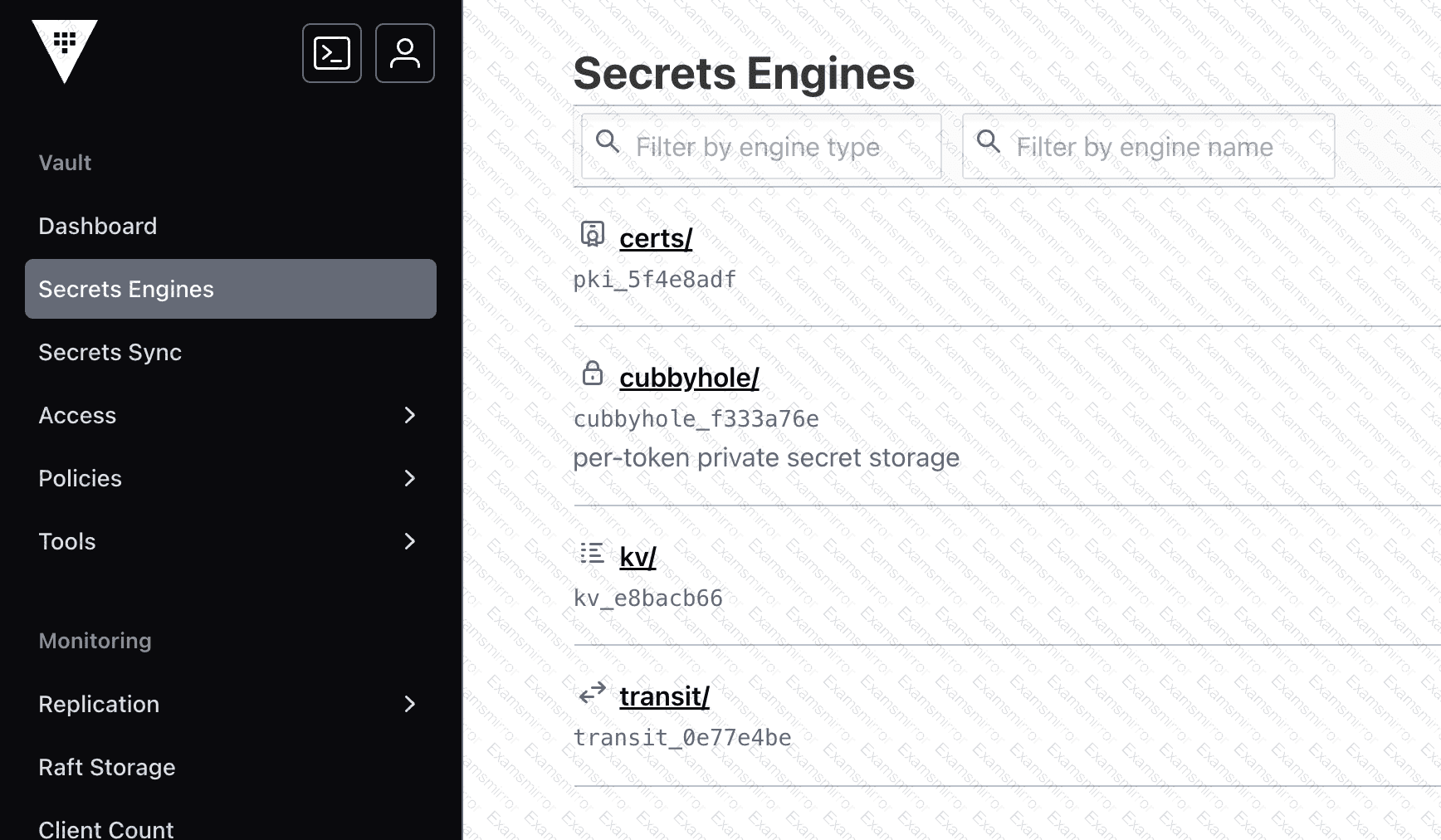
Question # 16

Options:

A.

2

B.

3

C.

4

D.

5

Questions # 17:

Which is true about Vault authentication responses when using the Vault API?

Options:

A.

The Vault API cannot be used for authentication.

B.

The returned tokens are not needed as all API endpoints are unauthenticated.

C.

The returned tokens should be deleted to avoid any use in future requests.

D.

The returned token must be passed in the request header.

Questions # 18:

What artifacts allow you to regenerate a root token after you have revoked it?

Pick the 2 correct responses below.

Options:

A.

Access to the OS root user.

B.

Policy with sudo access.

C.

Initial root token.

D.

Unseal keys.

E.

Recovery keys.

Questions # 19:

In regards to the Transit secrets engine, which of the following is true given the following command and output (select three):

$ vault write encryption/encrypt/creditcard plaintext=$(base64 < < < " 1234 5678 9101 1121 " )

Key: ciphertext Value: vault:v3:cZNHVx+sxdMErXRSuDa1q/pz49fXTn1PScKfhf+PIZPvy8xKfkytpwKcbC0fF2U=

Options:

A.

The Transit secrets engine is mounted at the encryption path

B.

The name of the keyring used to encrypt the data is creditcard

C.

There are at least three data keys associated with this keyring

D.

The data was written to the encryption path, which is provided by default when enabling the Transit secrets engine

Questions # 20:

Which of the following are replication methods available in Vault Enterprise? Choose two correct answers.

Options:

A.

Cluster sharding

B.

Namespaces

C.

Performance Replication

D.

Disaster Recovery Replication

Viewing page 2 out of 10 pages
Viewing questions 11-20 out of questions
TOP CODES

TOP CODES

Top selling exam codes in the certification world, popular, in demand and updated to help you pass on the first try.