
Summer Certification Limited Time 70% Discount Offer - Ends in 0d 00h 00m 00s - Coupon code = getmirror

Pass the Huawei HCIA-Cloud Service H13-811_V3.5 Questions and answers with ExamsMirror

Practice at least 50% of the questions to maximize your chances of passing.
Exam H13-811_V3.5 Premium Access

View all detail and faqs for the H13-811_V3.5 exam


0 Students Passed

0% Average Score

0% Same Questions
Viewing page 1 out of 2 pages
Viewing questions 1-10 out of questions
Questions # 1:

An ECS can be billed on a pay-per-use, yearly or monthly, or spot price basis. Only pay-per-use billing can reduce costs.

Options:

A.

TRUE

B.

FALSE

Questions # 2:

Hybrid cloud is a flexible cloud computing model. It may contain two cloud architectures: public cloud and private cloud, or even more. The infrastructure of a hybrid cloud is owned and operated by a single organization. Therefore, user services can switch between these clouds as required.

Options:

A.

TRUE

B.

FALSE

Questions # 3:

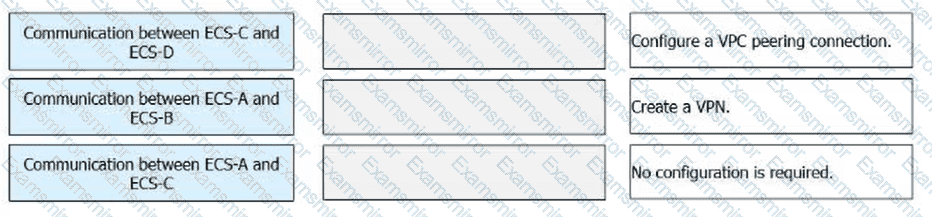
A user creates two Virtual Private Clouds (VPCs) (VPC 1 and VPC 2) in the CN North-Beijing4 region, and two Elastic Cloud Servers (ECSs), ECS-A and ECS-B, respectively, in VPC 1 and VPC 2. The user then creates another VPC in the CN East-Shanghai1 region, and two ECSs (ECS-C and ECS-D) in that VPC as well. The user needs to enable communications between different ECSs, match different scenarios with corresponding solutions:
Question # 3

Options:

Questions # 4:

NAT Gateway provides network address translation between private networks and between private and public networks.

Options:

A.

TRUE

B.

FALSE

Questions # 5:

Which of the following are functions of Cloud Trace Service (CTS)?

Options:

A.

Trace file encryption

B.

Trace recording

C.

Trace transfer

D.

Trace query

Questions # 6:

Which of the following statements is incorrect about the relationship between Bare Metal Server (BMS) and other cloud services?

Options:

A.

With Auto Scaling (AS), users can flexibly scale in and out BMSs by customizing AS configurations and policies, reducing resource consumption and saving money on O & M.

B.

With Cloud Eye, users can monitor BMSs. After Agent is installed on a BMS, the Agent will report monitoring data to Cloud Eye.

C.

With Elastic Volume Service (EVS), users can attach EVS disks to a BMS and expand their capacity at any time.

D.

With Image Management Service (IMS), users can use images to batch create identical BMSs, improving service deployment efficiency.

Questions # 7:

Which of the following statements about container image is incorrect?

Options:

A.

A container image packages the entire running environment and images are built in a unified format.

B.

A container image integrates the operating system and application configurations.

C.

A private registry is required for container images.

D.

You can use a container image to run applications without changing software configurations in the image.

Questions # 8:

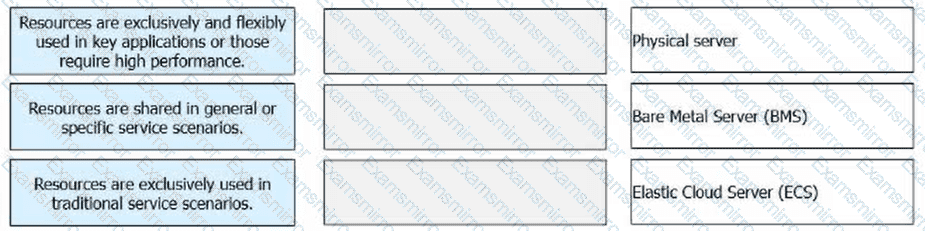
Match the following application scenarios with the corresponding server types:
Question # 8

Options:

Questions # 9:

Which of the following statements about security group configurations are correct?

Options:

A.

When creating an Elastic Cloud Server (ECS), users must select a security group.

B.

When selecting a security group, users can select the default security group or create one manually.

C.

Security groups protect ECSs and only support allow rules.

D.

The inbound and outbound rules of the default security group cannot be modified, but those of custom security groups can.

Questions # 10:

A user sets up a service website on Huawei Cloud Elastic Cloud Server (ECS) and uses Huawei Cloud Relational Database Service (RDS) on the backend to store service data. The database configuration is correct, but the website cannot communicate with the database. Which of the following can not be the cause of this issue?

Options:

A.

The ECS and RDS are in different security groups, and the security groups do not allow access from the connection port.

B.

The ECS and RDS are in two different Virtual Private Clouds (VPCs) and VPC peering connection is not configured.

C.

The password of the ECS is different from that of the RDS.

D.

The ECS port used for communication with the RDS is incorrectly configured.

Viewing page 1 out of 2 pages
Viewing questions 1-10 out of questions
TOP CODES

TOP CODES

Top selling exam codes in the certification world, popular, in demand and updated to help you pass on the first try.