
Halloween Sale Special Limited Time 75% Discount Offer - Ends in 0d 00h 00m 00s - Coupon code = drift75
Pass the IAPP Information Privacy Technologist CIPT Questions and answers with ExamsMirror
Exam CIPT Premium Access
View all detail and faqs for the CIPT exam
715 Students Passed
96% Average Score
92% Same Questions
An organization based in California, USA is implementing a new online helpdesk solution for recording customer call information. The organization considers the capture of personal data on the online helpdesk solution to be in the interest of the company in best servicing customer calls.
Before implementation, a privacy technologist should conduct which of the following?
SCENARIO
Clean-Q is a company that offers house-hold and office cleaning services. The company receives requests from consumers via their website and telephone, to book cleaning services. Based on the type and size of service, Clean-Q then contracts individuals that are registered on its resource database - currently managed in-house by Clean-Q IT Support. Because of Clean-Q's business model, resources are contracted as needed instead of permanently employed.
The table below indicates some of the personal information Clean-Q requires as part of its business operations:
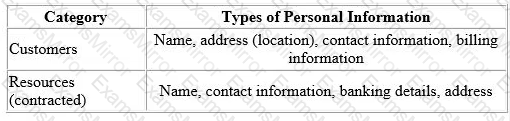
Clean-Q has an internal employee base of about 30 people. A recent privacy compliance exercise has been conducted to align employee data management and human resource functions with applicable data protection regulation. Therefore, the Clean-Q permanent employee base is not included as part of this scenario.
With an increase in construction work and housing developments, Clean-Q has had an influx of requests for cleaning services. The demand has overwhelmed Clean-Q's traditional supply and demand system that has caused some overlapping bookings.
Ina business strategy session held by senior management recently, Clear-Q invited vendors to present potential solutions to their current operational issues. These vendors included Application developers and Cloud-Q’s solution providers, presenting their proposed solutions and platforms.
The Managing Director opted to initiate the process to integrate Clean-Q's operations with a cloud solution (LeadOps) that will provide the following solution one single online platform: A web interface that Clean-Q accesses for the purposes of resource and customer management. This would entail uploading resource and customer information.
A customer facing web interface that enables customers to register, manage and submit cleaning service requests online.
A resource facing web interface that enables resources to apply and manage their assigned jobs.
An online payment facility for customers to pay for services.
Which question would you most likely ask to gain more insight about LeadOps and provide practical privacy recommendations?
Which of the following occurs when an individual takes a specific observable action to indicate and confirm that they give permission for their information to be processed?
Which Organization for Economic Co-operation and Development (OECD) privacy protection principle encourages an organization to obtain an individual s consent before transferring personal information?
Which of the following is a vulnerability of a sensitive biometrics authentication system?
SCENARIO
Looking back at your first two years as the Director of Personal Information Protection and Compliance for the Berry Country Regional Medical Center in Thorn Bay, Ontario, Canada, you see a parade of accomplishments, from developing state-of-the-art simulation based training for employees on privacy protection to establishing an interactive medical records system that is accessible by patients as well as by the medical personnel. Now, however, a question you have put off looms large: how do we manage all the data-not only records produced recently, but those still on hand from years ago? A data flow diagram generated last year shows multiple servers, databases, and work stations, many of which hold files that have not yet been incorporated into the new records system. While most of this data is encrypted, its persistence may pose security and compliance concerns. The situation is further complicated by several long-term studies being conducted by the medical staff using patient information. Having recently reviewed the major Canadian privacy regulations, you want to make certain that the medical center is observing them.
You also recall a recent visit to the Records Storage Section, often termed “The Dungeon” in the basement of the old hospital next to the modern facility, where you noticed a multitude of paper records. Some of these were in crates marked by years, medical condition or alphabetically by patient name, while others were in undifferentiated bundles on shelves and on the floor. The back shelves of the section housed data tapes and old hard drives that were often unlabeled but appeared to be years old. On your way out of the dungeon, you noticed just ahead of you a small man in a lab coat who you did not recognize. He carried a batch of folders under his arm, apparently records he had removed from storage.
Which regulation most likely applies to the data stored by Berry Country Regional Medical Center?

TOP CODES
Top selling exam codes in the certification world, popular, in demand and updated to help you pass on the first try.