Summer Certification Limited Time 70% Discount Offer - Ends in 0d 00h 00m 00s - Coupon code = getmirror

Pass the Juniper JNCIA JN0-106 Questions and answers with ExamsMirror

Practice at least 50% of the questions to maximize your chances of passing.
Exam JN0-106 Premium Access

View all detail and faqs for the JN0-106 exam


804 Students Passed

96% Average Score

97% Same Questions
Viewing page 2 out of 3 pages
Viewing questions 11-20 out of questions
Questions # 11:

You committed a new configuration on a Junos router, but users report connectivity issues. You must quickly restore the previous working configuration without manually editing the candidate configuration. Which command should you use to load the required configuration into the candidate configuration?

Options:

A.

rollback 0

B.

show | compare rollback

C.

rollback 1

D.

load override

Questions # 12:

What are two characteristics of transit traffic in Junos OS? (Choose two.)

Options:

A.

It includes routing protocol packets.

B.

It is traffic destined for the Routing Engine.

C.

It does not require control plane processing.

D.

It is forwarded by the Packet Forwarding Engine.

Questions # 13:

Which two tasks should be performed when creating a new user account on a Junos device? (Choose two.)

Options:

A.

Assign the user to a login class.

B.

Enable SSH for the user explicitly.

C.

Configure a password for the user.

D.

Configure the user to bypass authentication.

Questions # 14:

Which Junos tool should you use to identify the path that packets take through the network to a destination?

Options:

A.

monitor interface traffic

B.

traceroute

C.

SNMP

D.

ping

Questions # 15:

Which two statements about firewall filters are correct? (Choose two.)

Options:

A.

Firewall filters are stateful.

B.

Firewall filters can match Layer 4 parameters.

C.

Firewall filters can match Layer 7 parameters.

D.

Firewall filters are stateless.

Questions # 16:

What is the primary purpose of an IPv6 link-local address?

Options:

A.

to provide Layer 2 connectivity

B.

to assign a unique address for multicast traffic

C.

to enable communication between devices on the same segment

D.

to replace the default gateway in IPv6 networks

Questions # 17:

Which two statements about prefix lists in Junos are correct? (Choose two.)
Options:

A.

Prefix lists can be re-used in multiple routing policies.

B.

Prefix lists can be used in both firewall filters and routing policies.

C.

Prefix lists cannot be used in routing policies.

D.

Prefix lists cannot be used in firewall filters.

Questions # 18:

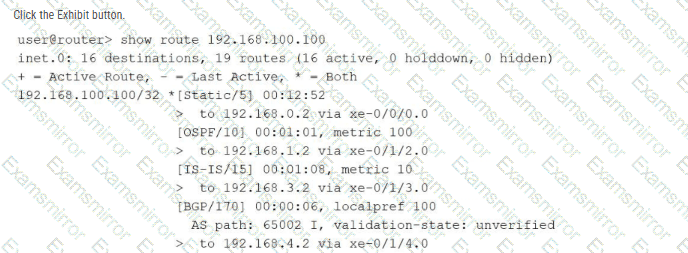
Question # 18

Referring to the exhibit using the show route 192.168.100.100 command output, over which interface will the traffic be forwarded?

Options:

A.

xe-0/1/3.0

B.

xe-0/0/0.0

C.

xe-0/1/4.0

D.

xe-0/1/2.0

Questions # 19:

Which two tasks would you perform in operational mode? (Choose two.)

Options:

A.

requesting the system to reboot

B.

verifying the version of Junos OS

C.

committing your configuration

D.

rolling back to a previous configuration

Questions # 20:

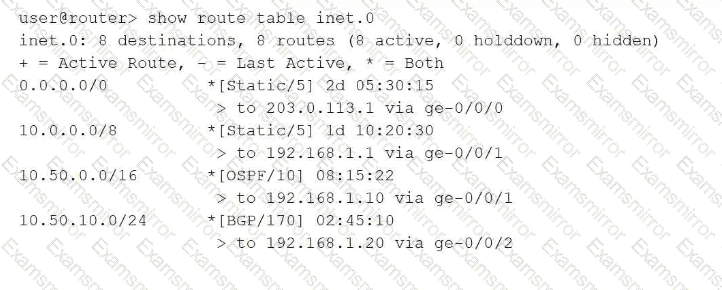
Exhibit:

Question # 20

Referring to the exhibit, which route will be selected for a packet destined to IP address 10.50.10.55?

Options:

A.

Route 0.0.0.0/0 will be selected using next hop 203.0.113.1 because the default route matches all destinations and has been active the longest.

B.

Route 10.50.0.0/16 will be selected using next hop 192.168.1.10 because OSPF has a better preference value than BGP.

C.

Route 10.50.10.0/24 will be selected using next hop 192.168.1.20 because it has the longest prefix match for the destination address.

D.

Route 10.0.0.0/8 will be selected using next hop 192.168.1.1 because it was learned from the static routing protocol which has the lowest preference value.

Viewing page 2 out of 3 pages
Viewing questions 11-20 out of questions
TOP CODES

TOP CODES

Top selling exam codes in the certification world, popular, in demand and updated to help you pass on the first try.