Pre-Summer Special Limited Time 70% Discount Offer - Ends in 0d 00h 00m 00s - Coupon code = getmirror

Pass the Netskope NCCSA NSK300 Questions and answers with ExamsMirror

Practice at least 50% of the questions to maximize your chances of passing.
Exam NSK300 Premium Access

View all detail and faqs for the NSK300 exam


765 Students Passed

94% Average Score

93% Same Questions
Viewing page 3 out of 3 pages
Viewing questions 21-30 out of questions
Questions # 21:

Your client is an NG-SWG customer. They are going to use the Explicit Proxy over Tunnel (EPoT) steering method. They have a specific list of domains that they do not want to steer to the Netskope Cloud.

What would accomplish this task''

Options:

A.

Define exception domains in the PAC file.

B.

Define exceptions in the Netskope steering configuration

C.

Create a real-time policy with a bypass action.

D.

Use an SSL decryption policy.

Questions # 22:

Your customer is currently using Directory Importer with Active Directory (AD) to provision users to Nelskope. They have recently acquired three new companies (A. B. and C) and want to onboard users from the companies onto the NetsKope platform. Information about the companies is shown below.

- Company A uses Active Directory.

-- Company B uses Azure AD.

-- Company C uses Okta Universal Directory.

Which statement is correct in this scenario?

Options:

A.

Users from Company B and Company C cannot be provisioned because the customer is already using AD Importer.

B.

Either Company B or Company C users cannot be provisioned because integration with only one SCIM solution is allowed.

C.

Users from Companies A. B, and C can be provisioned to Netskope by deploying additional AD Importers and integrating more than one SCIM solution.

D.

Company A users cannot be provisioned to Netskope because the customer is already using AD Importer to import users from another Active Directory environment.

Questions # 23:

You deployed Netskope Cloud Security Posture Management (CSPM) using pre-defined benchmark rules to monitor your cloud posture in AWS, Azure, and GCP. You are asked to assess if you can extend the Netskope CSPM solution by creating custom rules for each environment.

Which statement is correct?

Options:

A.

Custom rules using Domain Specific Language are only available when using SSPM.

B.

You will need to evaluate SaaS Security Posture Management (SSPM) in addition to CSPM so that rules applied to GCP will align with Google Workspace

C.

With Netskope CSPM, you can create custom rules using Domain Specific Language for AWS. Azure, but not for GCP.

D.

With Netskope CSPM, you can create custom rules using Domain Specific Language for AWS. Azure, and GCP

Questions # 24:

Given the following:

Question # 24

Which result does this Skope IT query provide?

Options:

A.

The query returns all events of user@company.com downloading or uploading to or from the site 'Amazon S3" using the Netskope Client.

B.

The query returns all events of an IP address downloading or uploading to or from Amazon S3 using the Netskope Client.

C.

The query returns all events of everyone except user@company.com downloading or uploading to or from the site "Amazon S3" using the Netskope Client.

D.

The query returns all events of user@company.com downloading or uploading to or from the application "Amazon S3" using the Netskope Client.

Questions # 25:

A company's architecture includes a server subnet that is logically isolated from the rest of the network with no Internet access, no default gateway, and no access to DNS. New resources can only be provisioned on virtual resources in that segment and there is a firewall that is tunnel-capable securing the perimeter of the segment. The only requirement is to have content filtering for any server that might access the Internet using a browser.

Which two Netskope deployment methods would achieve this requirement? (Choose two.)

Options:

A.

Deploy a mobile profile on the servers.

B.

Deploy Data Plane on Premises (DPoP) with a proxy configuration on the servers.

C.

Deploy IPsec or GRE tunnels in the segment to steer traffic from the servers to Netskope.

D.

Install the Netskope Client on the servers

Questions # 26:

You have deployed Netskope to all users of the organization and you are now ready to begin ingesting all events, alerts, and Web transactions into your SIEM as a part of your requirements.

What are three ways in which you would accomplish this task? (Choose three.)

Options:

A.

Use custom API calls to ingest to a data lake and then into your SIEM.

B.

Use the Netskope Publisher to a stream syslog to your SIEM.

C.

Use syslog directly to Splunk.

D.

Use Cloud Log Shipper to an IaaS storage repository and then into your SIEM.

Questions # 27:

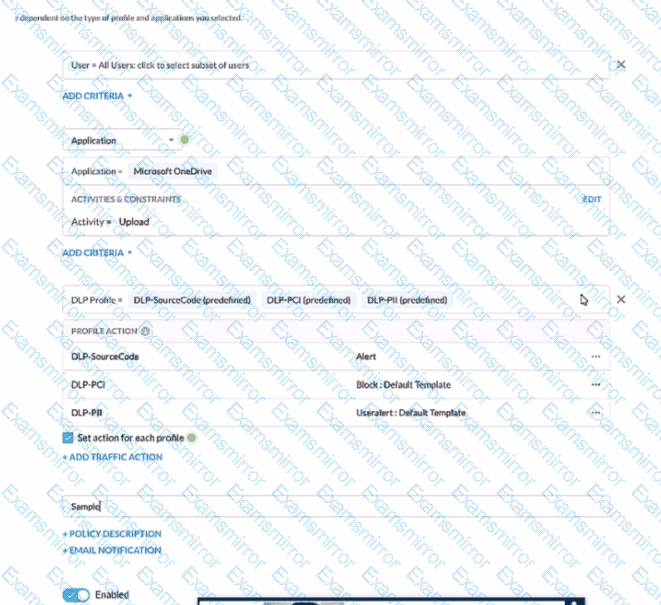
Review the exhibit.

Question # 27

A user has attempted to upload a file to Microsoft OneDrive that contains source code with Pll and PCI data.

Referring to the exhibit, which statement Is correct?

Options:

A.

The user will be blocked and a single Incident will be generated referencing the DLP-PCI profile.

B.

The user will be blocked and a single Incident will be generated referencing all of the matching DLP profiles

C.

The user will be blocked and a separate incident will be generated for each of the matching DLP profiles.

D.

The user will be alerted and a single incident will be generated referencing the DLP-PII profile.

Questions # 28:

You need to monitor the health of configured IPsec or GRE tunnels.

In this scenario, which two methods are supported by Netskope to accomplish this task? (Choose two.)

Options:

A.

Use Layer 4 health checks.

B.

Use Dead Peer Detection.

C.

Use ICMP keepalive probing.

D.

Use Netskope Trust Portal.

Questions # 29:

A company has deployed Explicit Proxy over Tunnel (EPoT) for their VDI users They have configured Forward Proxy authentication using Okta Universal Directory They have also configured a number of Real-time Protection policies that block access to different Web categories for different AD groups so. for example, marketing users are blocked from accessing gambling sites. During User Acceptance Testing, they see inconsistent results where sometimes marketing users are able to access gambling sites and sometimes they are blocked as expected They are seeing this inconsistency based on who logs into the VDI server first.

What is causing this behavior?

Options:

A.

Forward Proxy is not configured to use the Cookie Surrogate

B.

Forward Proxy is not configured to use the IP Surrogate

C.

Forward Proxy authentication is configured but not enabled.

D.

Forward Proxy is configured to use the Cookie Surrogate

Questions # 30:

You are implementing Netskope Cloud Exchange in your company lo include functionality provided by third-party partners. What would be a reason for using Netskope Cloud Risk Exchange in this scenario?

Options:

A.

to ingest events and alerts from a Netskope tenant

B.

to feed SOC with detection and response services

C.

to map multiple scores to a normalized range

D.

to automate service tickets from alerts of interest

Viewing page 3 out of 3 pages
Viewing questions 21-30 out of questions
TOP CODES

TOP CODES

Top selling exam codes in the certification world, popular, in demand and updated to help you pass on the first try.