Summer Certification Limited Time 70% Discount Offer - Ends in 0d 00h 00m 00s - Coupon code = getmirror

Pass the Nokia Certified Data Center Fabric Professional 4A0-D03 Questions and answers with ExamsMirror

Practice at least 50% of the questions to maximize your chances of passing.
Exam 4A0-D03 Premium Access

View all detail and faqs for the 4A0-D03 exam


0 Students Passed

0% Average Score

0% Same Questions
Viewing page 2 out of 2 pages
Viewing questions 11-20 out of questions
Questions # 11:

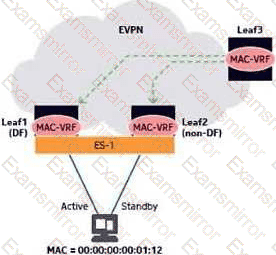
Consider the exhibit.

Question # 11

Which of the following statements about the configuration and operation of this setup is TRUE?

Options:

A.

The MAC-VRF on Leaf1 and Leaf2 is configured with multi-homing-mode all-active.

B.

The MAC-VRF on Leaf3 will need to be configured with ECMP to be able to load balance between Leaf1 and Leaf2.

C.

The host will be required to be configured with a LAG.

D.

The Ethernet segment ES-1 will be associated to the ports that connect to the host.

Questions # 12:

Leaf routers are configured to support Layer 2 multi-homing all-active mode.

Which of the following statements is FALSE?

Options:

A.

A LAG must be configured on the participating leaf routers.

B.

If VLAN tagging is to be used, then it must be enabled on the LAG interface.

C.

If using LACP, the system-id-mac must uniquely identify each leaf router connected to the host.

D.

The LAG interface must then be associated with the Ethernet segment.

Questions # 13:

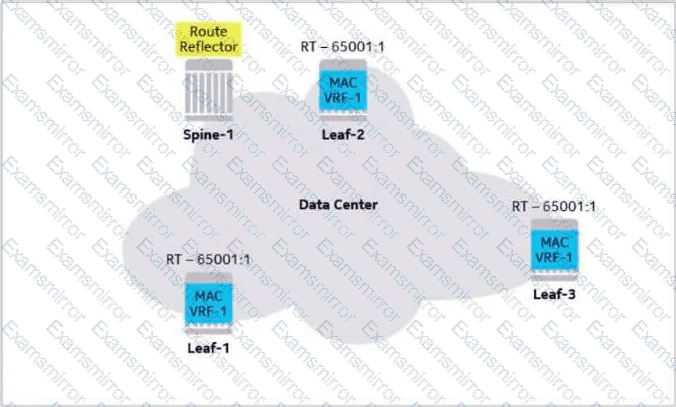
Consider the exhibit.

Question # 13

All three leafs have an EVPN MP-BGP session with the route reflector in Spine-1. Leaf-2 and Leaf-3 have existing instances of an L2 EVPN named MAC VRF-1. Leaf-1 has just enabled a new instance of MAC VRF-1.

Which of the following steps is NOT taken when this new instance is enabled?

Options:

A.

Leaf-1 generates an IMET route.

B.

Leaf-1 advertises the IMET route in a BGP EVPN update directly to Leaf-2 and Leaf-3.

C.

Leaf-2 and Leaf-3 auto-discover the new peer based on the route target in the received IMET route.

D.

Leaf-2 and Leaf-3 add Leaf-1 to their existing flooding list for BUM traffic.

Questions # 14:

Which EVPN route-type (RT) is used in multi-homing scenarios to support aliasing and fast convergence?

Options:

A.

RT-1 Ethernet Auto-Discovery

B.

RT-2 MAC/IP Advertisement

C.

RT-3 Inclusive Multicast Ethernet Tag

D.

RT-4 Ethernet Segment

Questions # 15:

Which of the following statements about a L3 EVPN network using symmetric routing is FALSE?

Options:

A.

Each participating PE must support the use of EVPN route-type 5.

B.

Ingress and egress PEs perform MAC and IP forwarding.

C.

A routed-VXLAN interface is required on a per IP-VRF basis.

D.

Each MAC-VRF used in the L3 EVPN network must exist on each PE.

Questions # 16:

Which of the following statements about EVPN PE-CE routing, using BGP as the routing protocol, is FALSE?

Options:

A.

The PE advertises IPv4/IPv6 BGP updates to the CE based on the EVPN routes received from other PEs.

B.

The PE advertises updates received from the CE as EVPN route type 5 updates to the other PEs.

C.

iBGP is preferred between the CE and PE so that they will be in the same autonomous system.

D.

The PE and CE can utilize import and export policies to control the updates that are sent and received.

Questions # 17:

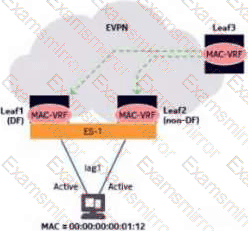
Consider the exhibit.

Question # 17

Which of the following statements about the configuration and operation of this setup is FALSE?

Options:

A.

A sub-interface of lag1 is associated to the MAC-VRF on Leaf1 and Leaf2.

B.

The Ethernet segment ES-1 is configured with multi-homing-mode all-active.

C.

The MAC-VRF on Leaf3 will need to be configured with ECMP to be able to load balance between Leaf1 and Leaf2.

D.

The host will forward all BUM traffic toward the DF.

Questions # 18:

Which of the following statements about PE-CE routing is FALSE?

Options:

A.

There are two methods to implement routing between the PE and CE, static and dynamic.

B.

BGP is the preferred option for PE-CE routing as it scales better than static routing.

C.

eBGP is preferred which means that the PE and CE are required to be in different autonomous systems.

D.

The CE advertises BGP EVPN route type 5 updates to the PE and the PE forwards to other PEs.

Questions # 19:

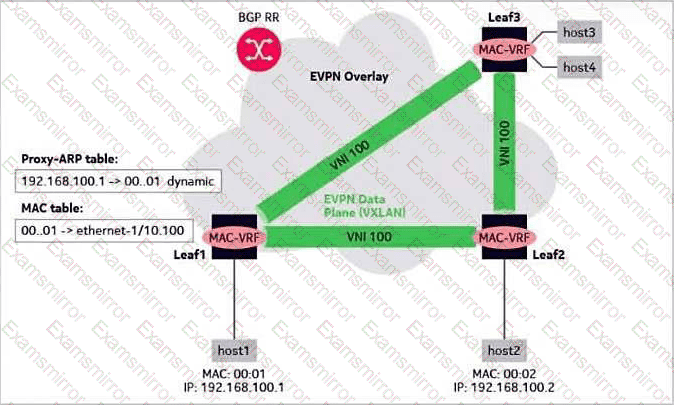
Consider the exhibit.

Question # 19

Leaf-1 has received an ARP request from host-1 for host-2. Leaf-1 has added host-1's MAC address in its MAC table and host-1's MAC/IP addresses in its proxy-ARP table.

Which of the following steps is FALSE?

Options:

A.

Leaf-1 sends a route-type 2 EVPN update with host-1's MAC with the IP address set to 0.0.0.0 to the remote peers.

B.

Leaf-1 sends a route-type 2 EVPN update with host-1's MAC with the IP address set to 192.168.100.1 to the remote peers.

C.

The remote peers ignore the EVPN update with the IP address set to 0.0.0.0 and use the update with the IP address set to 192.168.100.1 to populate their MAC forwarding tables.

D.

The remote peers generate a gratuitous ARP towards their directly connected hosts to announce the learned IP/MAC mapping information.

Questions # 20:

An IRB sub-interface that is being used to interconnect a MAC-VRF to an IP-VRF, is configured with anycast-gw set to true and anycast-gw enabled.

Which of the following statements is FALSE?

Options:

A.

The last octet of the default virtual MAC assigned to the sub-interface is derived from the last octet of the chassis MAC.

B.

The same IP address used on this sub-interface can be used by other IRB sub-interfaces on remote PEs participating in the IP-VRF.

C.

The host IP address of the sub-interface appears in the IP-VRF route table along with the prefix for the entire sub-net.

D.

Two MAC addresses associated to the sub-interface are shown in the forwarding table of the MAC-VRF that contains the IRB sub-interface.

Viewing page 2 out of 2 pages
Viewing questions 11-20 out of questions
TOP CODES

TOP CODES

Top selling exam codes in the certification world, popular, in demand and updated to help you pass on the first try.