
Pre-Winter Sale Limited Time 70% Discount Offer - Ends in 0d 00h 00m 00s - Coupon code = getmirror
Pass the Oracle Java SE 1z0-809 Questions and answers with ExamsMirror
Exam 1z0-809 Premium Access
View all detail and faqs for the 1z0-809 exam
686 Students Passed
85% Average Score
95% Same Questions
Given:
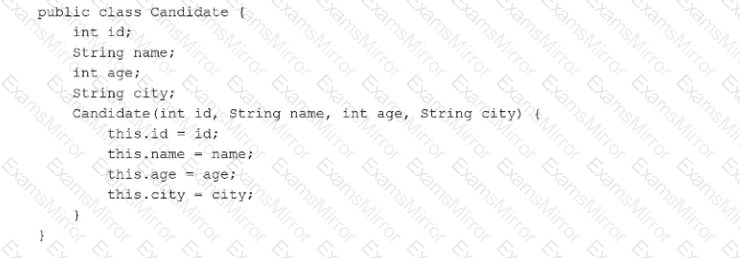
and the code fragment:

Assuming candlist contains Candidate objects, which code fragment calculates the average age of candidates from NewYork?
Options:




Given the code fragments:
class ThreadRunner implements Runnable {
public void run () { System.out.print (“Runnable”) ; }
}
class ThreadCaller implements Callable {
Public String call () throws Exception {return “Callable”; )
}
and
ExecutorService es = Executors.newCachedThreadPool ();
Runnable r1 = new ThreadRunner ();
Callable c1 = new ThreadCaller ();
// line n1
es.shutdown();
Which code fragment can be inserted at line n1 to start r1 and c1 threads?
Which action can be used to load a database driver by using JDBC3.0?
Given the code fragment:
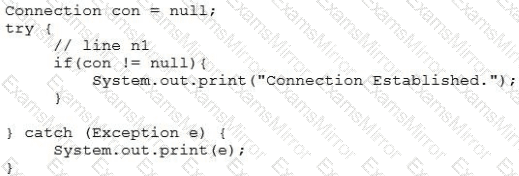
Assume that dbURL, userName, and password are valid.
Which code fragment can be inserted at line n1 to enable the code to print Connection Established?
Given the code fragment:
public class Foo {
public static void main (String [ ] args) {
Map
unsortMap.put (10, “z”);
unsortMap.put (5, “b”);
unsortMap.put (1, “d”);
unsortMap.put (7, “e”);
unsortMap.put (50, “j”);
Map
Comparator
@Override public int compare (Integer o1, Integer o2) {return o2.compareTo
(o1); } } );
treeMap.putAll (unsortMap);
for (Map.Entry
System.out.print (entry.getValue () + “ “);
}
}
}
What is the result?
Which two reasons should you use interfaces instead of abstract classes? (Choose two.)
Given that course.txt is accessible and contains:
Course : : Java
and given the code fragment:
public static void main (String[ ] args) {
int i;
char c;
try (FileInputStream fis = new FileInputStream (“course.txt”);
InputStreamReader isr = new InputStreamReader(fis);) {
while (isr.ready()) { //line n1
isr.skip(2);
i = isr.read ();
c = (char) i;
System.out.print(c);
}
} catch (Exception e) {
e.printStackTrace();
}
}
What is the result?
Which statement is true about the single abstract method of the java.util.function.Function interface?
Given the definition of the Emp class:
public class Emp
private String eName;
private Integer eAge;
Emp(String eN, Integer eA) {
this.eName = eN;
this.eAge = eA;
}
public Integer getEAge () {return eAge;}
public String getEName () {return eName;}
}
and code fragment:
List
Predicate
li = li.stream().filter(agVal).collect(Collectors.toList());
Stream
names.forEach(n -> System.out.print(n + “ “));
What is the result?
Given the code fragment:
Path source = Paths.get (“/data/december/log.txt”);
Path destination = Paths.get(“/data”);
Files.copy (source, destination);
and assuming that the file /data/december/log.txt is accessible and contains:
10-Dec-2014 – Executed successfully
What is the result?

TOP CODES
Top selling exam codes in the certification world, popular, in demand and updated to help you pass on the first try.