
Pre-Winter Sale Limited Time 70% Discount Offer - Ends in 0d 00h 00m 00s - Coupon code = getmirror
Pass the PECB ISO 45001 ISO-45001-Lead-Auditor Questions and answers with ExamsMirror
Exam ISO-45001-Lead-Auditor Premium Access
View all detail and faqs for the ISO-45001-Lead-Auditor exam
739 Students Passed
91% Average Score
96% Same Questions
You are conducting a Stage 2 certification audit to ISO 45001 at an adventure park in the Scottish Highlands. The park offers treetop walks, zip-line rides, walking trails, and horse-riding trips. The park is open to adults and children of any age. You are particularly interested in compliance with legal requirements and interview the Park Manager.
You: How do you evaluate the risks to participants that the various activities present?
Park Manager: Our risks are covered by insurance, and we operate under health and safety legislation that requires frequent checks of all our facilities. For example, we trust staff to check all our harnesses every morning.
You: Are you required to have an independent inspection carried out of zip lines, for example?
Park Manager: Yes, our insurance company employs a reputable body to do that sort of thing.
You: Can you show me a copy of the latest inspection report? Park Manager: I’d need to get that from the insurance organisation. I have the initial one when we opened eight years ago.
You examine the inspection report, which takes the form of a checklist that does not identify individual zip lines, treetop platforms, harnesses, or rope ladders. It is dated eight years previously and has a scribbled signature with no other identification of the inspection engineer. Select the two statements for which there is evidence of a nonconformity to ISO 45001.
Select two statements.
To verify information, auditors need to use a combination of open and closed questions.
In what two situations would you use a ' closed ' question?
Based on the image you provided, the question asks to identify which two phrases would apply to a first-party audit.
A multi-level shopping centre is open every day to the public from 09:00–21:00. During an external audit of the centre to ISO 45001, you establish that there are 120 retail outlets. There are eight escalators to all levels and four sets of elevators. When asked about safety performance improvement objectives, the Centre Manager says that there are plans to reduce the number of reported incidents and complaints.
You: I note from the incident log that reported incidents have increased in the past year. Why is this?
Centre Manager: The number of shoppers coming into the centre has increased by about 10 per cent in the last year. More people around means that more things will happen.
You: What actions have been taken to deal with this increase?
Centre Manager: We conducted awareness training for staff. For example, making sure that any hazardous areas are well signed.
You: I see that the escalators account for a number of accidents. Have you taken any actions to try and reduce this?
Centre Manager: Most of these accidents are caused by people failing to take care at the ends. So, the answer is no, it is difficult to do anything about that.
You: How do you monitor safety in the centre?
Centre Manager: We train our staff to be alert to potential safety problems when walking around the centre. We empower them to take whatever action is necessary.
Which four actions should you take to investigate the situation further?
You are the audit team leader on a two-day surveillance audit of an organisation based in Milano, Italy. You have planned to interview the General Manager at 4 pm on day two, just before the closing meeting.
When you discuss the audit plan with the auditee before the audit, you are told that the General Manager will be in Zurich for the whole week. He offers to hold a virtual meeting as planned from the hotel where he will be staying.
Which one of the following would be your best answer?
Whistlekleen is a national dry cleaning and laundry organization with 50 shops. You are conducting an OHSMS surveillance audit of the head office and are sampling health and safety performance monitoring. You find that 80 per cent of incident originate from five shops in the same region. Most of these relate to staff and customer feeling unwell due to breathing in the pungent atmosphere. Some required to be hospitalized. The OHS Manager tells you that these are the oldest shops in the organization. The cleaning equipment emits Volatile Organic Compounds (VOCs) and needs replacing but the organisation cannot afford it at the moment.
An audit team leader is interviewing a member of top management in respect of the organisation ' s performance evaluation processes. It is clear to the audit team leader that there is some confusion as to difference between monitoring and measurement.
Which three of the following statements by the member of top management are correct?
You are conducting a Stage 2 audit of a fast-food provider that operates three local restaurants.
Earlier in the day, you visited restaurant no. 2, where you noted there were no first aid kits or fire extinguishers present on site.
You are now interviewing the Chief Executive Officer, and you ask him if he is aware of the absence of OHS equipment at restaurant 2. He confirms that he is and says that this is because all the restaurant equipment was removed from the room, and next week, the new restaurant equipment will start being installed.
He shows you a management of change record that confirms this and identifies several potential risks arising from the equipment refresh. A single action is recorded that states, “Close restaurant 2 to the public until replacement equipment is installed and staff are trained on its use.”
How should you react? Select one.
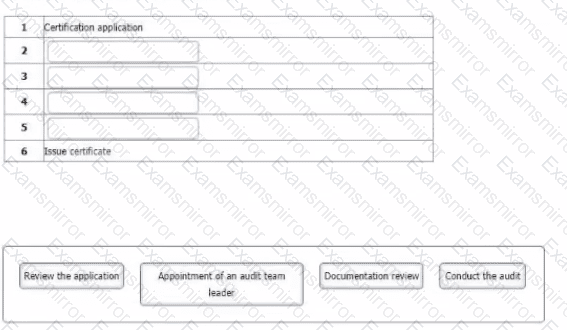
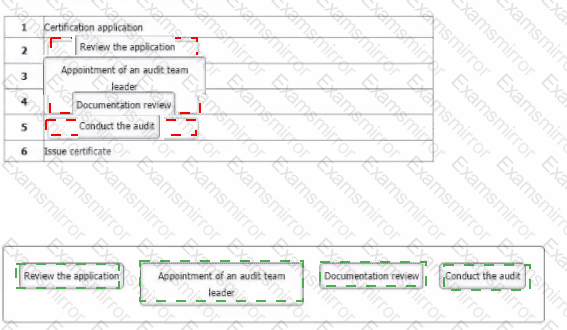
The following options show key actions involved in a third-party audit. They are not in order. Order the stages in the table to show the sequence in which the actions should take place.
To complete the sequence click on the blank section you want to complete so it is highlighted in red and then click on the applicable stage from the options below. Alternatively, drag and drop the options to the appropriate blank section.
These stages take place after a certification application.
Which three of the following statements about closing meetings are true?

TOP CODES
Top selling exam codes in the certification world, popular, in demand and updated to help you pass on the first try.