
Black Friday Grand offer - Upto 75% off - Ends in 0d 00h 00m 00s - Coupon code = drift75

Pass the Salesforce MuleSoft Mule-Dev-301 Questions and answers with ExamsMirror

Practice at least 50% of the questions to maximize your chances of passing.
Exam Mule-Dev-301 Premium Access

View all detail and faqs for the Mule-Dev-301 exam


0 Students Passed

0% Average Score

0% Same Questions
Viewing page 1 out of 2 pages
Viewing questions 1-10 out of questions
Questions # 1:

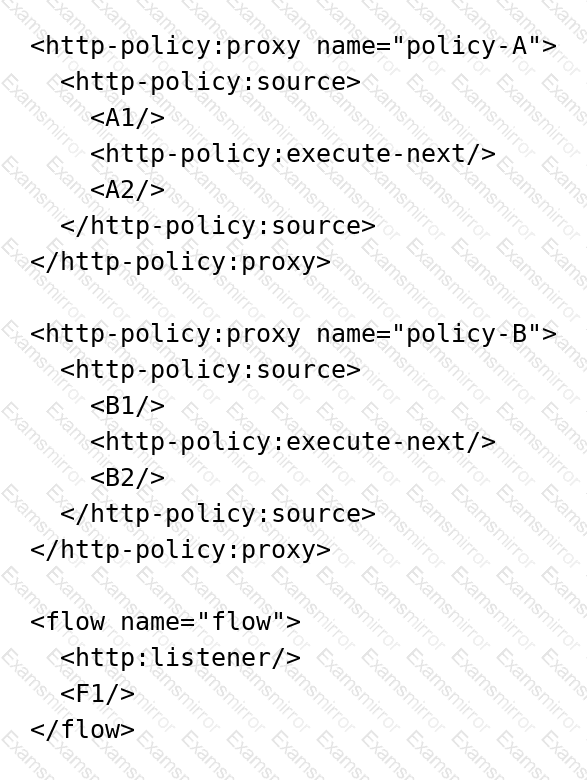
Refer to the exhibits.

A Mule application contains two policies: Policy A and Policy B. Policy A has order 1, and Policy B has order 2. Policy A, Policy B, and a flow are defined by the configurations below.

When an HTTP request arrives at the Mule application's endpoint, what will be the execution order?

Exhibit:
Question # 1

Options:

A.

A1, B1, F1, B2, A2

B.

B1, A1, F1, A2, B2

C.

F1, A1, B1, B2, A2

D.

F1, B1, A1, A2, B2

Questions # 2:

A developer is working on a project that requires encrypting all data before sending it to a backend application. To accomplish this, the developer will use PGP encryption in the Mule 4 Cryptography module.

What is required to encrypt the data before sending it to the backend application?

Options:

A.

The application needs the public key from the backend service to encrypt the data

B.

The application needs both the private and public keys to encrypt the data

C.

The application needs the private key from the backend service to encrypt the data

D.

The application needs to configure HTTPS TLS context information to encrypt the data

Questions # 3:

Which statement is true when working with correlation IDs?

Options:

A.

The VM Connector does not automatically propagate correlation IDs

B.

The HTTP Listener regenerates correlation IDs regardless of the HTTP request

C.

The HTTP Listener generates correlation IDs unless a correlation ID is received in the HTTP request

D.

The Anypoint MQ Connector automatically propagates correlation IDs

Questions # 4:

Which pattern can a web API use to notify its client of state changes as soon as they occur?

Options:

A.

ETL data load

B.

Schedule Event Publisher

C.

HTTP Webhook

D.

Shared database trigger

Questions # 5:

An API has been developed and deployed to CloudHub. Among the policies applied to this API is an allowlist of IP addresses. A developer wants to run a test in Anypoint Studio and does not want any policies applied because their workstation is not included in the allowlist.

What must the developer do in order to run this test locally without the policies applied?

Options:

A.

Pass in the runtime parameter "-Danypoint.platform.gatekeeper=disabled"

B.

Deactivate the API in API Manager so the Autodiscovery element will not find the application when it runs in Studio

C.

Run the test as-is, with no changes, because the Studio runtime will not attempt to connect to API Manager

D.

Create a properties file specifically for local development and set the API instance ID to a value that is not used in API Manager

Questions # 6:

Which command is used to convert a JKS keystore to PKCS12?

Options:

A.

keytool -importkeystore -srckeystore keystore.jks -srcstoretype PKCS12 -destkeystore keystore.p12 -deststoretype JKS

B.

keytool -importkeystore -srckeystore keystore.jks -srcstoretype JKS -destkeystore keystore.p12 -deststoretype PKCS12

C.

keytool -importkeystore -srckeystore keystore.p12 -srcstoretype PKCS12 -destkeystore keystore.jks -deststoretype JKS

D.

keytool -importkeystore -srckeystore keystore.p12 -srcstoretype JKS -destkeystore keystore.p12 -deststoretype PKCS12

Questions # 7:

An organization uses CloudHub to deploy all of its applications.

How can a common-global-error-handler flow be configured so that it can be reused across all of the organization's deployed applications?

Options:

A.

Create a Mule plugin project. Create a common-global-error-handler flow inside the plugin project. Use this plugin as a dependency in all Mule applications. Import that configuration file in Mule applications.

B.

Create a Mule domain project. Create a common-global-error-handler flow inside the domain project. Use this domain project as a dependency.

C.

Create a Mule plugin project. Create a common-global-error-handler flow inside the plugin project. Use this plugin as a dependency in all Mule applications.

D.

Create a common-global-error-handler flow in all Mule applications. Refer to it via flow-ref wherever needed.

Questions # 8:

When registering a client application with an existing API instance or API Group instance, what is required to manually approve or reject request access?

Options:

A.

To only have Exchange Administrator permission

B.

To configure the SLA tier for the application and have the Exchange Administrator permission

C.

To configure the SLA tier for the application and have the role of Organization Administrator, API Manager Environment Administrator, or the Manage Contracts permission

D.

To configure the SLA tier for the application

Questions # 9:

A company with MuleSoft Titanium support develops a Salesforce System API using MuleSoft's out-of-the-box Salesforce Connector and deploys the API to CloudHub.

Which steps provide the average number of requests and average response time of the Salesforce Connector?

Options:

A.

Access Anypoint Monitoring's built-in dashboard. Select a resource. Locate the information under the Connectors tab.

B.

Access Anypoint Monitoring's built-in dashboard. Select a resource. Locate the information under Log Management > Raw Data.

C.

Access Anypoint Monitoring's built-in dashboard. Select a resource. Create a custom dashboard to retrieve the information.

D.

Change the API implementation to capture the information in the log. Retrieve the information from the log file.

Questions # 10:

A Mule application uses API autodiscovery to access and enforce policies for a RESTful implementation.

What needs to be configured for the flowRef attribute of the autodiscovery global element?

Options:

A.

The name of the flow that has APIkit Console to receive all incoming RESTful operation requests

B.

Nothing because flowRef is an optional attribute which can be passed during runtime

C.

The name of the flow that has HTTP Listener to receive all incoming RESTful operation requests

D.

Any of the APIkit generated implementation flows

Viewing page 1 out of 2 pages
Viewing questions 1-10 out of questions
TOP CODES

TOP CODES

Top selling exam codes in the certification world, popular, in demand and updated to help you pass on the first try.