
Black Friday Grand offer - Upto 75% off - Ends in 0d 00h 00m 00s - Coupon code = drift75

Pass the UiPath Certified Professional - Agentic Automation Track UiPath-AAPv1 Questions and answers with ExamsMirror

Practice at least 50% of the questions to maximize your chances of passing.
Exam UiPath-AAPv1 Premium Access

View all detail and faqs for the UiPath-AAPv1 exam


0 Students Passed

0% Average Score

0% Same Questions
Viewing page 3 out of 4 pages
Viewing questions 21-30 out of questions
Questions # 21:

In the illustrated insurance-claim automation, the agent analyzes incoming emails and escalates uncertain cases for confirmation before proceeding.

When configuring Human-in-the-Loop for this process, which configuration best ensures accurate claim identification while maintaining automation efficiency?
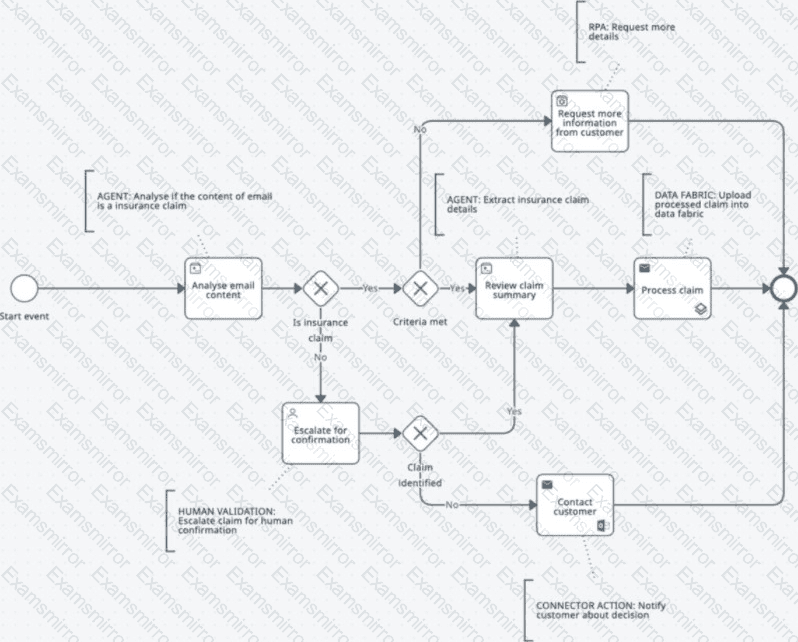
Question # 21

Original exhibit — Question 2

Options:

A.

Configure human approval before notifying the customer of the final claim decision, regardless of how the claim was classified.

B.

Configure human validation for a subset of processed claims selected based on predefined business priority categories.

C.

Configure escalation to a human reviewer when the agent can't confidently confirm the email is an insurance claim.

D.

Configure human review after the claim summary is generated to validate extracted details prior to uploading the processed claim into the data fabric.

Questions # 22:

When a team requires safe, cost-effective testing without calling real tool endpoints or escalation paths, which capability best supports this testing approach?

Options:

A.

Use simulations to run evaluations with mocked tool and escalation behaviors

B.

Use evaluators to run evaluations with mocked tool and escalation behaviors

C.

Use evaluation results to run evaluations with mocked tool and escalation behaviors

D.

Use evaluation sets to run evaluations with mocked tool and escalation behaviors

Questions # 23:

Which approach follows best practices for implementing a multi-agent system?

Options:

A.

Design agents to collaborate and coordinate at runtime, using shared memory or communication layers to negotiate objectives, distribute tasks, and adapt dynamically to changing conditions.

B.

Limit agent interaction to prevent complexity, assigning each agent a static function that never changes throughout the workflow lifecycle.

C.

Focus on repetitive, rules-based automations where agents follow fixed, deterministic paths and do not require adaptive planning or coordination.

D.

Define all control logic and task order during the initial design phase, ensuring agents execute a predetermined set of actions without deviation, following fixed rules and deterministic paths.

Questions # 24:

What changes would improve clarity and specificity when an agent does not escalate high-value refund requests because the prompt merely says large refunds should be "handled carefully" without defining a clear threshold?

Options:

A.

Encourage the agent to use its judgment when determining whether a refund amount is significant.

B.

Emphasize that large refunds require attention and rely on the agent to interpret what qualifies as large.

C.

Add more contextual background about refund policies without specifying measurable escalation criteria.

D.

Define a precise refund amount threshold and clearly state when escalation to a human must occur.

Questions # 25:

An organization is assessing a proposed agent story to determine whether it meaningfully addresses operational challenges.

Which evaluation criterion aligns most directly with agentic discovery principles?

Options:

A.

Verify that the agent story increases the total number of automated steps across the process.

B.

Verify that the agent story introduces additional architectural complexity to support future scalability.

C.

Verify that the agent story corresponds to documented inefficiencies and decisions from the "as-is" analysis.

D.

Verify that the agent story expands automation scope beyond the boundaries of the documented workflow.

Questions # 26:

A team wants to compare several model and temperature combinations side by side using the same evaluation scenarios and expected outputs.

What action creates a separate evaluation run for each configuration?

Options:

A.

Add multiple evaluator types to the same set where each evaluator creates a separate run for scoring the models.

B.

Add multiple model and temperature combinations in Evaluation settings so each combination creates a separate run.

C.

Generate multiple evaluation sets so each of the sets creates a separate run for the same input cases.

D.

Import multiple JSON files so each imported file creates a separate run for the same evaluations.

Questions # 27:

A team is iterating on an agent that books meeting rooms and wants to determine whether recent prompt changes have improved the agent's accuracy.

How do evaluations support this iterative development process?

Options:

A.

Evaluations automatically roll back agent changes when the new score is lower than the previous score to maintain consistent agent quality.

B.

Evaluations generate a detailed diff report highlighting exact prompt token changes that caused performance degradation between two agent versions.

C.

Evaluations can be run repeatedly after each change, producing scores that allow developers to compare performance across different iterations of the agent.

D.

Evaluations automatically apply suggested prompt improvements based on failed cases and re-run the test suite until the score improves.

Questions # 28:

How are activity input methods configured in UiPath agent tools, and what are the main considerations for cascading fields?

Options:

A.

Activity input methods include Prompt (default), Argument, and Static Value. Cascading fields cannot use the Prompt input method as agents cannot infer changes in field structures at runtime.

B.

Activity input methods are mostly limited to Prompt, though in some cases Argument or Static Value can be selected depending on the connector. Cascading fields generally work with the Prompt method because agents can usually handle dynamic field updates during execution without major issues.

C.

Activity input methods are fully automated with no optional configurations available. Cascading fields do not impact agent tool functionality in any way.

D.

Activity input methods primarily default to Static Value for most fields to ensure predictable behavior and minimize runtime errors. Cascading fields are automatically detected and adjusted by the agent at runtime for smooth handling of dependent or conditional inputs.

Questions # 29:

Which filters can be applied to refine the data displayed on the Monitoring tab?

Options:

A.

Advanced filters override basic filters completely, making version and date range irrelevant when both are applied.

B.

You can apply both basic filters and advanced filters to refine the displayed data.

C.

Filters can only be applied after exporting the data, the Monitoring tab itself does not support filtering.

D.

Only basic filters such as version and date range are available, element and variable-level filters are not supported.

Questions # 30:

Which of the following actions would most directly improve an agent's score in the "Prompt" component?

Options:

A.

Increasing the model's context window allocation to allow more detailed background information in each run

B.

Refactoring tool definitions to enforce stricter parameter validation and more predictable tool invocation patterns

C.

Expanding the evaluation dataset to increase coverage and reduce variance in prompt performance scoring

D.

Refining the agent's system prompt to clarify role, objectives, constraints, and reasoning structure

Viewing page 3 out of 4 pages
Viewing questions 21-30 out of questions
TOP CODES

TOP CODES

Top selling exam codes in the certification world, popular, in demand and updated to help you pass on the first try.