
Halloween Sale Special Limited Time 75% Discount Offer - Ends in 0d 00h 00m 00s - Coupon code = drift75
Pass the Amazon Web Services AWS Certified Data Engineer Data-Engineer-Associate Questions and answers with ExamsMirror
Exam Data-Engineer-Associate Premium Access
View all detail and faqs for the Data-Engineer-Associate exam
705 Students Passed
91% Average Score
94% Same Questions
A company has a frontend ReactJS website that uses Amazon API Gateway to invoke REST APIs. The APIs perform the functionality of the website. A data engineer needs to write a Python script that can be occasionally invoked through API Gateway. The code must return results to API Gateway.
Which solution will meet these requirements with the LEAST operational overhead?
A company receives .csv files that contain physical address data. The data is in columns that have the following names: Door_No, Street_Name, City, and Zip_Code. The company wants to create a single column to store these values in the following format:
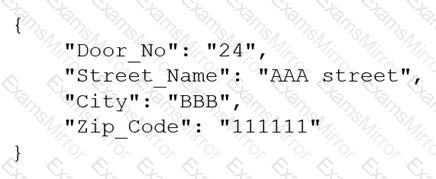
Which solution will meet this requirement with the LEAST coding effort?
A company wants to migrate a data warehouse from Teradata to Amazon Redshift. Which solution will meet this requirement with the LEAST operational effort?
An ecommerce company processes millions of orders each day. The company uses AWS Glue ETL to collect data from multiple sources, clean the data, and store the data in an Amazon S3 bucket in CSV format by using the S3 Standard storage class. The company uses the stored data to conduct daily analysis.
The company wants to optimize costs for data storage and retrieval.
Which solution will meet this requirement?
A company is designing a serverless data processing workflow in AWS Step Functions that involves multiple steps. The processing workflow ingests data from an external API, transforms the data by using multiple AWS Lambda functions, and loads the transformed data into Amazon DynamoDB.
The company needs the workflow to perform specific steps based on the content of the incoming data.
Which Step Functions state type should the company use to meet this requirement?
A manufacturing company wants to collect data from sensors. A data engineer needs to implement a solution that ingests sensor data in near real time.
The solution must store the data to a persistent data store. The solution must store the data in nested JSON format. The company must have the ability to query from the data store with a latency of less than 10 milliseconds.
Which solution will meet these requirements with the LEAST operational overhead?
A telecommunications company collects network usage data throughout each day at a rate of several thousand data points each second. The company runs an application to process the usage data in real time. The company aggregates and stores the data in an Amazon Aurora DB instance.
Sudden drops in network usage usually indicate a network outage. The company must be able to identify sudden drops in network usage so the company can take immediate remedial actions.
Which solution will meet this requirement with the LEAST latency?
A company is building an inventory management system and an inventory reordering system to automatically reorder products. Both systems use Amazon Kinesis Data Streams. The inventory management system uses the Amazon Kinesis Producer Library (KPL) to publish data to a stream. The inventory reordering system uses the Amazon Kinesis Client Library (KCL) to consume data from the stream. The company configures the stream to scale up and down as needed.
Before the company deploys the systems to production, the company discovers that the inventory reordering system received duplicated data.
Which factors could have caused the reordering system to receive duplicated data? (Select TWO.)
A company manages an Amazon Redshift data warehouse. The data warehouse is in a public subnet inside a custom VPC A security group allows only traffic from within itself- An ACL is open to all traffic.
The company wants to generate several visualizations in Amazon QuickSight for an upcoming sales event. The company will run QuickSight Enterprise edition in a second AW5 account inside a public subnet within a second custom VPC. The new public subnet has a security group that allows outbound traffic to the existing Redshift cluster.
A data engineer needs to establish connections between Amazon Redshift and QuickSight. QuickSight must refresh dashboards by querying the Redshift cluster.
Which solution will meet these requirements?
A company created an extract, transform, and load (ETL) data pipeline in AWS Glue. A data engineer must crawl a table that is in Microsoft SQL Server. The data engineer needs to extract, transform, and load the output of the crawl to an Amazon S3 bucket. The data engineer also must orchestrate the data pipeline.
Which AWS service or feature will meet these requirements MOST cost-effectively?

TOP CODES
Top selling exam codes in the certification world, popular, in demand and updated to help you pass on the first try.