
Summer Certification Limited Time 70% Discount Offer - Ends in 0d 00h 00m 00s - Coupon code = getmirror

Pass the Amazon Web Services AWS Certified Professional DOP-C02 Questions and answers with ExamsMirror

Practice at least 50% of the questions to maximize your chances of passing.
Exam DOP-C02 Premium Access

View all detail and faqs for the DOP-C02 exam


718 Students Passed

90% Average Score

90% Same Questions
Viewing page 4 out of 14 pages
Viewing questions 31-40 out of questions
Questions # 31:

A company is using an AWS CodeBuild project to build and package an application. The packages are copied to a shared Amazon S3 bucket before being deployed across multiple AWS accounts.

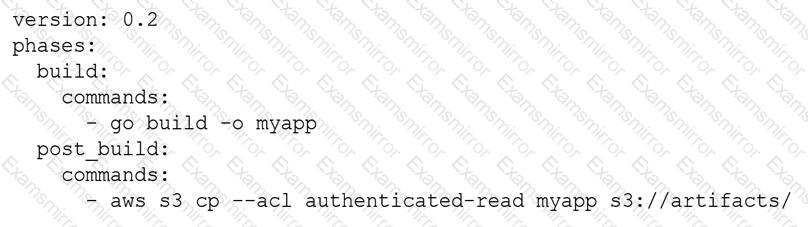
The buildspec.yml file contains the following:
Question # 31

The DevOps engineer has noticed that anybody with an AWS account is able to download the artifacts.

What steps should the DevOps engineer take to stop this?

Options:

A.

Modify the post_build command to use --acl public-read and configure a bucket policy that grants read access to the relevant AWS accounts only.

B.

Configure a default ACL for the S3 bucket that defines the set of authenticated users as the relevant AWS accounts only and grants read-only access.

C.

Create an S3 bucket policy that grants read access to the relevant AWS accounts and denies read access to the principal “*”.

D.

Modify the post_build command to remove --acl authenticated-read and configure a bucket policy that allows read access to the relevant AWS accounts only.

Questions # 32:

A company operates sensitive workloads across the AWS accounts that are in the company ' s organization in AWS Organizations The company uses an IP address range to delegate IP addresses for Amazon VPC CIDR blocks and all non-cloud hardware.

The company needs a solution that prevents principals that are outside the company ' s IP address range from performing AWS actions In the organization ' s accounts

Which solution will meet these requirements?

Options:

A.

Configure AWS Firewall Manager for the organization. Create an AWS Network Firewall policy that allows only source traffic from the company ' s IP address range Set the policy scope to all accounts in the organization.

B.

In Organizations, create an SCP that denies source IP addresses that are outside of the company s IP address range. Attach the SCP to the organization ' s root

C.

Configure Amazon GuardDuty for the organization. Create a GuardDuty trusted IP address list for the company ' s IP range Activate the trusted IP list for the organization.

D.

In Organizations, create an SCP that allows source IP addresses that are inside of the company s IP address range. Attach the SCP to the organization ' s root.

Questions # 33:

A company has developed a web application that conducts seasonal sales on public holidays. The web application is deployed on AWS and uses AWS services for storage, database, computing, and encryption. During seasonal sales, the company expects high network traffic from many users. The company must receive insights regarding any unexpected behavior during the sale. A DevOps team wants to review the insights upon detecting anomalous behaviors during the sale. The DevOps team wants to receive recommended actions to resolve the anomalous behaviors. The recommendations must be provided on the provisioned infrastructure to address issues that might occur in the future.

Which combination of steps will meet these requirements with the LEAST operational overhead? (Select TWO.)

Options:

A.

Enable Amazon DevOps Guru in the AWS account. Determine the coverage for DevOps Guru for all supported AWS resources in the account. Use the DevOps Guru dashboard to find the analysis, recommendations, and related metrics.

B.

Create an Amazon Simple Notification Service (Amazon SNS) topic. Configure Amazon DevOps Guru to send notifications about important events to the company when anomalies are identified.

C.

Create an Amazon S3 bucket. Store Amazon CloudWatch logs, AWS CloudTrail data, and AWS Config data in the S3 bucket. Use Amazon Athena to generate insights on the data. Create a dashboard by using Amazon QuickSight.

D.

Configure email message reports for an Amazon QuickSight dashboard. Schedule and send the email reports to the company.

E.

Create an Amazon Simple Notification Service (Amazon SNS) topic. Configure Amazon Athena to send query results about important events to the company when anomalies are identified.

Questions # 34:

A company uses an organization in AWS Organizations to manage 10 AWS accounts. All features are enabled, and trusted access for AWS CloudFormation is enabled.

A DevOps engineer needs to use CloudFormation to deploy an IAM role to the Organizations management account and all member accounts in the organization.

Which solution will meet these requirements with the LEAST operational overhead?

Options:

A.

Create a CloudFormation StackSet that has service-managed permissions. Set the root OU as a deployment target.

B.

Create a CloudFormation StackSet that has service-managed permissions. Set the root OU as a deployment target. Deploy a separate CloudFormation stack in the Organizations management account.

C.

Create a CloudFormation StackSet that has self-managed permissions. Set the root OU as a deployment target.

D.

Create a CloudFormation StackSet that has self-managed permissions. Set the root OU as a deployment target. Deploy a separate CloudFormation stack in the Organizations management account.

Questions # 35:

A company uses AWS and has a VPC that contains critical compute infrastructure with predictable traffic patterns. The company has configured VPC flow logs that are published to a log group in Amazon CloudWatch Logs.

The company ' s DevOps team needs to configure a monitoring solution for the VPC flow logs to identify anomalies in network traffic to the VPC over time. If the monitoring solution detects an anomaly, the company needs the ability to initiate a response to the anomaly.

How should the DevOps team configure the monitoring solution to meet these requirements?

Options:

A.

Create an Amazon Kinesis data stream. Subscribe the log group to the data stream. Configure Amazon Kinesis Data Analytics to detect log anomalies in the data stream. Create anAWS Lambda function to use as the output of the data stream. Configure the Lambda function to write to the default Amazon EventBridge event bus in the event of an anomaly finding.

B.

Create an Amazon Kinesis Data Firehose delivery stream that delivers events to an Amazon S3 bucket. Subscribe the log group to the delivery stream. Configure Amazon Lookout for Metrics to monitor the data in the S3 bucket for anomalies. Create an AWS Lambda function to run in response to Lookout for Metrics anomaly findings. Configure the Lambda function to publish to the default Amazon EventBridge event bus.

C.

Create an AWS Lambda function to detect anomalies. Configure the Lambda function to publish an event to the default Amazon EventBridge event bus if the Lambda function detects an anomaly. Subscribe the Lambda function to the log group.

D.

Create an Amazon Kinesis data stream. Subscribe the log group to the data stream. Create an AWS Lambda function to detect log anomalies. Configure the Lambda function to write to the default Amazon EventBridge event bus if the Lambda function detects an anomaly. Set the Lambda function as the processor for the data stream.

Questions # 36:

A company is running an application on Amazon EC2 instances in an Auto Scaling group. Recently an issue occurred that prevented EC2 instances from launching successfully and it took several hours for the support team to discover the issue. The support team wants to be notified by email whenever an EC2 instance does not start successfully.

Which action will accomplish this?

Options:

A.

Add a health check to the Auto Scaling group to invoke an AWS Lambda function whenever an instance status is impaired.

B.

Configure the Auto Scaling group to send a notification to an Amazon SNS topic whenever a failed instance launch occurs.

C.

Create an Amazon CloudWatch alarm that invokes an AWS Lambda function when a failed Attachinstances Auto Scaling API call is made.

D.

Create a status check alarm on Amazon EC2 to send a notification to an Amazon SNS topic whenever a status check fail occurs.

Questions # 37:

A company has a mission-critical application on AWS that uses automatic scaling The company wants the deployment lilecycle to meet the following parameters.

• The application must be deployed one instance at a time to ensure the remaining fleet continues to serve traffic

• The application is CPU intensive and must be closely monitored

• The deployment must automatically roll back if the CPU utilization of the deployment instance exceeds 85%.

Which solution will meet these requirements?

Options:

A.

Use AWS CloudFormalion to create an AWS Step Functions state machine and Auto Scaling hfecycle hooks to move to one instance at a time into a wait state Use AWS Systems Manager automation to deploy the update to each instance and move it back into the Auto Scaling group using the heartbeat timeout

B.

Use AWS CodeDeploy with Amazon EC2 Auto Scaling. Configure an alarm tied to the CPU utilization metric. Use the CodeDeployDefault OneAtAtime configuration as a deployment strategy Configure automatic rollbacks within the deployment group to roll back the deployment if the alarm thresholds are breached

C.

Use AWS Elastic Beanstalk for load balancing and AWS Auto Scaling Configure an alarm tied to the CPU utilization metric Configure rolling deployments with a fixed batch size of one instance Enable enhanced health to monitor the status of the deployment and roll back based on the alarm previously created.

D.

Use AWS Systems Manager to perform a blue/green deployment with Amazon EC2 Auto Scaling Configure an alarm tied to the CPU utilization metric Deploy updates one at a time Configure automatic rollbacks within the Auto Scaling group to roll back the deployment if the alarm thresholds are breached

Questions # 38:

A company uses an organization in AWS Organizations to manage multiple AWS accounts. The company needs a solution to detect sensitive information in Amazon S3 buckets in all the company’s accounts. When the solution detects sensitive data, the solution must collect all the findings and make them available to the company’s security officer in a single location. The solution must move S3 objects that contain sensitive information to a quarantine S3 bucket.

Which solutions will meet these requirements with the LEAST operational overhead? (Select TWO.)

Options:

A.

Enable AWS Security Hub in the organization. Enable Amazon Macie for all the accounts in the organization. Configure Macie to send findings to Security Hub.

B.

Create an AWS Service Catalog product to provision S3 buckets. Configure Service Catalog to create a new S3 bucket. Configure S3 Event Notifications to send ObjectCreated events to an Amazon Simple Queue Service (Amazon SQS) queue.

C.

Create an AWS Lambda function to copy S3 objects from S3 buckets to a dedicated quarantine bucket. Configure the Lambda function to delete copied objects from the original buckets. Configure an Amazon EventBridge rule to invoke the Lambda function in response to sensitive information findings from Amazon Macie.

D.

Configure an AWS Lambda function to run when new objects are created or when existing objects are updated. Configure the Lambda function to determine whether objects contain sensitive data. Configure the function to move objects that contain sensitive data to a quarantine bucket and to delete the original objects.

E.

Configure SCPs to prevent the creation of S3 buckets and objects that contain suspected sensitive data. Configure the SCPs to move objects that are suspected to contain sensitive data to a dedicated quarantine S3 bucket.

Questions # 39:

To run an application, a DevOps engineer launches an Amazon EC2 instance with public IP addresses in a public subnet. A user data script obtains the application artifacts and installs them on the instances upon launch. A change to the security classification of the application now requires the instances to run with no access to the internet. While the instances launch successfully and show as healthy, the application does not seem to be installed.

Which of the following should successfully install the application while complying with the new rule?

Options:

A.

Launch the instances in a public subnet with Elastic IP addresses attached. Once the application is installed and running, run a script to disassociate the Elastic IP addresses afterwards.

B.

Set up a NAT gateway. Deploy the EC2 instances to a private subnet. Update the private subnet ' s route table to use the NAT gateway as the default route.

C.

Publish the application artifacts to an Amazon S3 bucket and create a VPC endpoint for S3. Assign an IAM instance profile to the EC2 instances so they can read the application artifacts from the S3 bucket.

D.

Create a security group for the application instances and allow only outbound traffic to the artifact repository. Remove the security group rule once the install is complete.

Questions # 40:

A company is using AWS CodePipeline to automate its release pipeline. AWS CodeDeploy is being used in the pipeline to deploy an application to Amazon Elastic Container Service (Amazon ECS) using the blue/green deployment model. The company wants to implement scripts to test the green version of the application before shifting traffic. These scripts will complete in 5 minutes or less. If errors are discovered during these tests, the application must be rolled back.

Which strategy will meet these requirements?

Options:

A.

Add a stage to the CodePipeline pipeline between the source and deploy stages. Use AWS CodeBuild to create a runtime environment and build commands in the buildspec file to invoke test scripts. If errors are found, use the aws deploy stop-deployment command to stop the deployment.

B.

Add a stage to the CodePipeline pipeline between the source and deploy stages. Use this stage to invoke an AWS Lambda function that will run the test scripts. If errors are found, use the aws deploy stop-deployment command to stop the deployment.

C.

Add a hooks section to the CodeDeploy AppSpec file. Use the AfterAllowTestTraffic lifecycle event to invoke an AWS Lambda function to run the test scripts. If errors are found, exit the Lambda function with an error to initiate rollback.

D.

Add a hooks section to the CodeDeploy AppSpec file. Use the AfterAllowTraffic lifecycle event to invoke the test scripts. If errors are found, use the aws deploy stop-deployment CLI command to stop the deployment.

Viewing page 4 out of 14 pages
Viewing questions 31-40 out of questions
TOP CODES

TOP CODES

Top selling exam codes in the certification world, popular, in demand and updated to help you pass on the first try.