Pre-Summer Special Limited Time 70% Discount Offer - Ends in 0d 00h 00m 00s - Coupon code = getmirror

Pass the GAQM Information Systems Security CPEH-001 Questions and answers with ExamsMirror

Practice at least 50% of the questions to maximize your chances of passing.
Exam CPEH-001 Premium Access

View all detail and faqs for the CPEH-001 exam


697 Students Passed

84% Average Score

91% Same Questions
Viewing page 4 out of 15 pages
Viewing questions 46-60 out of questions
Questions # 46:

If there is an Intrusion Detection System (IDS) in intranet, which port scanning technique cannot be used?

Options:

A.

Spoof Scan

B.

TCP Connect scan

C.

TCP SYN

D.

Idle Scan

Questions # 47:

You want to do an ICMP scan on a remote computer using hping2. What is the proper syntax?

Options:

A.

hping2 host.domain.com

B.

hping2 --set-ICMP host.domain.com

C.

hping2 -i host.domain.com

D.

hping2 -1 host.domain.com

Questions # 48:

Which of these is capable of searching for and locating rogue access points?

Options:

A.

HIDS

B.

WISS

C.

WIPS

D.

NIDS

Questions # 49:

Cryptography is the practice and study of techniques for secure communication in the presence of third parties (called adversaries.) More generally, it is about constructing and analyzing protocols that overcome the influence of adversaries and that are related to various aspects in information security such as data confidentiality, data integrity, authentication, and non-repudiation. Modern cryptography intersects the disciplines of mathematics, computer science, and electrical engineering. Applications of cryptography include ATM cards, computer passwords, and electronic commerce.

Basic example to understand how cryptography works is given below:

Question # 49

Which of the following choices is true about cryptography?

Options:

A.

Algorithm is not the secret, key is the secret.

B.

Symmetric-key algorithms are a class of algorithms for cryptography that use the different cryptographic keys for both encryption of plaintext and decryption of ciphertext.

C.

Secure Sockets Layer (SSL) use the asymmetric encryption both (public/private key pair) to deliver the shared session key and to achieve a communication way.

D.

Public-key cryptography, also known as asymmetric cryptography, public key is for decrypt, private key is for encrypt.

Questions # 50:

To maintain compliance with regulatory requirements, a security audit of the systems on a network must be performed to determine their compliance with security policies. Which one of the following tools would most likely be used in such an audit?

Options:

A.

Vulnerability scanner

B.

Protocol analyzer

C.

Port scanner

D.

Intrusion Detection System

Questions # 51:

Risks = Threats x Vulnerabilities is referred to as the:

Options:

A.

Risk equation

B.

Threat assessment

C.

BIA equation

D.

Disaster recovery formula

Questions # 52:

Which method of password cracking takes the most time and effort?

Options:

A.

Brute force

B.

Rainbow tables

C.

Dictionary attack

D.

Shoulder surfing

Questions # 53:

Todd has been asked by the security officer to purchase a counter-based authentication system. Which of the following best describes this type of system?

Options:

A.

A biometric system that bases authentication decisions on behavioral attributes.

B.

A biometric system that bases authentication decisions on physical attributes.

C.

An authentication system that creates one-time passwords that are encrypted with secret keys.

D.

An authentication system that uses passphrases that are converted into virtual passwords.

Questions # 54:

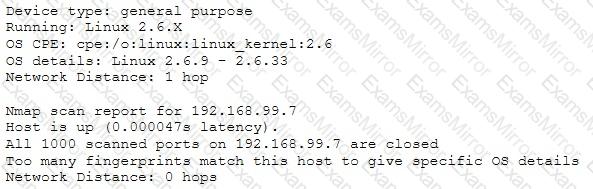
Emil uses nmap to scan two hosts using this command.

nmap -sS -T4 -O 192.168.99.1 192.168.99.7

He receives this output:
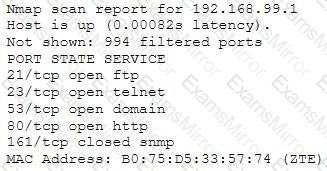
Question # 54

Question # 54

What is his conclusion?

Options:

A.

Host 192.168.99.7 is an iPad.

B.

He performed a SYN scan and OS scan on hosts 192.168.99.1 and 192.168.99.7.

C.

Host 192.168.99.1 is the host that he launched the scan from.

D.

Host 192.168.99.7 is down.

Questions # 55:

An Intrusion Detection System (IDS) has alerted the network administrator to a possibly malicious sequence of packets sent to a Web server in the network's external DMZ. The packet traffic was captured by the IDS and saved to a PCAP file.

What type of network tool can be used to determine if these packets are genuinely malicious or simply a false positive?

Options:

A.

Protocol analyzer

B.

Intrusion Prevention System (IPS)

C.

Network sniffer

D.

Vulnerability scanner

Questions # 56:

The "white box testing" methodology enforces what kind of restriction?

Options:

A.

The internal operation of a system is completely known to the tester.

B.

Only the external operation of a system is accessible to the tester.

C.

Only the internal operation of a system is known to the tester.

D.

The internal operation of a system is only partly accessible to the tester.

Questions # 57:

Which of the following programming languages is most susceptible to buffer overflow attacks, due to its lack of a built-in-bounds checking mechanism?
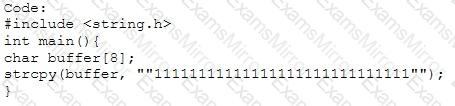
Question # 57

Output:

Segmentation fault

Options:

A.

C#

B.

Python

C.

Java

D.

C++

Questions # 58:

To determine if a software program properly handles a wide range of invalid input, a form of automated testing can be used to randomly generate invalid input in an attempt to crash the program.

What term is commonly used when referring to this type of testing?

Options:

A.

Fuzzing

B.

Randomizing

C.

Mutating

D.

Bounding

Questions # 59:

Bob learned that his username and password for a popular game has been compromised. He contacts the company and resets all the information. The company suggests he use two-factor authentication, which option below offers that?

Options:

A.

A new username and password

B.

A fingerprint scanner and his username and password.

C.

Disable his username and use just a fingerprint scanner.

D.

His username and a stronger password.

Questions # 60:

Which of the following is one of the most effective ways to prevent Cross-site Scripting (XSS) flaws in software applications?

Options:

A.

Validate and escape all information sent to a server

B.

Use security policies and procedures to define and implement proper security settings

C.

Verify access right before allowing access to protected information and UI controls

D.

Use digital certificates to authenticate a server prior to sending data

Viewing page 4 out of 15 pages
Viewing questions 46-60 out of questions
TOP CODES

TOP CODES

Top selling exam codes in the certification world, popular, in demand and updated to help you pass on the first try.