Summer Certification Limited Time 70% Discount Offer - Ends in 0d 00h 00m 00s - Coupon code = getmirror

Pass the Juniper JNCIS-ENT JN0-352 Questions and answers with ExamsMirror

Practice at least 50% of the questions to maximize your chances of passing.
Exam JN0-352 Premium Access

View all detail and faqs for the JN0-352 exam


0 Students Passed

0% Average Score

0% Same Questions
Viewing page 1 out of 2 pages
Viewing questions 1-10 out of questions
Questions # 1:

[Exhibit]

Question # 1

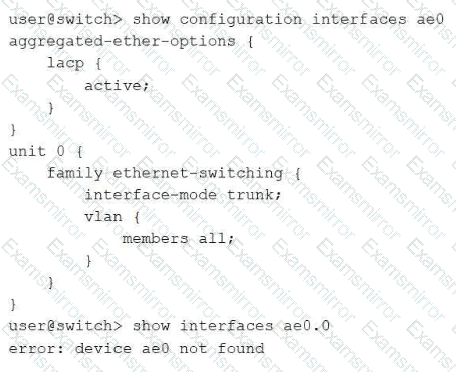
Click the Exhibit button.

You are troubleshooting an aggregated Ethernet interface on a Juniper Networks EX Series Switch. The aggregated Ethernet interface does not appear in the output shown in the exhibit.

Which action will solve this problem?

Options:

A.

Configure the number of aggregated Ethernet devices under the [edit chassis] hierarchy.

B.

Install the aggregated Ethernet interface license on the switch.

C.

Restart the switch to enable the aggregated Ethernet switching process.

D.

Configure LACP passive-mode.

Questions # 2:

Which statement is correct about how a Juniper Networks EX Series Switch learns MAC addresses?

Options:

A.

The switch adds destination MAC addresses to the bridge table after forwarding frames.

B.

The switch learns MAC addresses by polling connected hosts periodically.

C.

The switch learns MAC addresses only after a spanning-tree topology change occurs.

D.

The switch learns source MAC addresses from received frames and records the ingress interface and timestamp.

Questions # 3:

Which statement describes how Rapid Spanning Tree Protocol (RSTP) identifies an alternate port?

Options:

A.

An alternate port is the upstream port that is not receiving BPDUs from the root bridge.

B.

An alternate port is the upstream port that provides the least-cost path to the root bridge.

C.

An alternate port is the upstream port that provides a backup path to the root bridge and stays in the discarding state.

D.

An alternate port is the upstream port that forwards traffic only when the designated port is overloaded.

Questions # 4:

[Exhibit]

Question # 4

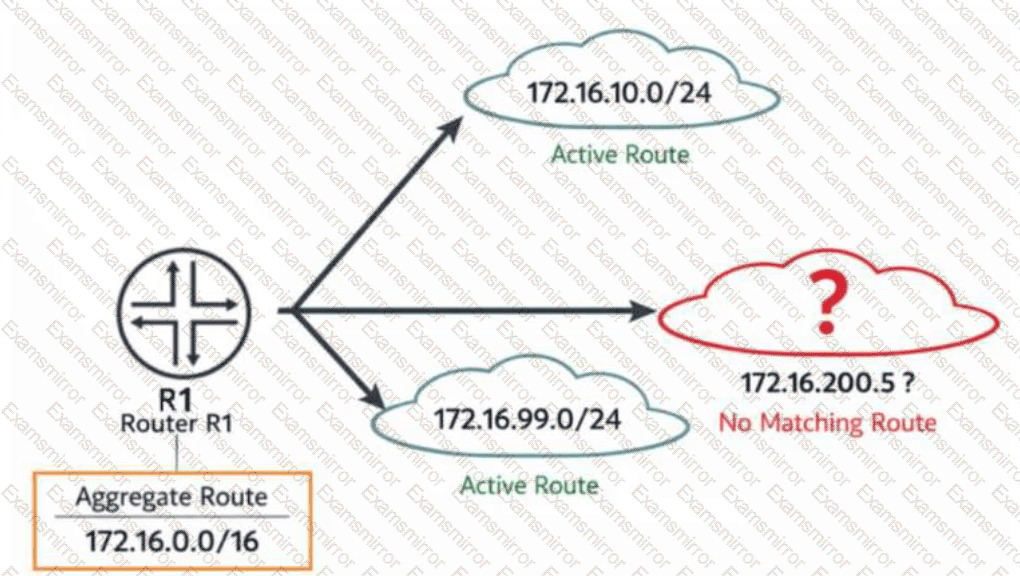
Click the Exhibit button.

You configure the aggregate route 172.16.0.0/16 on router R1. The routing table currently contains active routes for 172.16.10.0/24 and 172.16.99.0/24. No other more-specific routes exist.

Referring to the exhibit, which statement describes what R1 would do with traffic destined to 172.16.200.5?

Options:

A.

R1 forwards the packet to the default route.

B.

R1 drops the packet and deactivates the aggregate route.

C.

R1 drops the packet and sends an ICMP unreachable message.

D.

R1 forwards the packet using the next hop of the active contributing route.

Questions # 5:

How does BGP prevent routing loops between internal peers?

Options:

A.

It uses VRRP.

B.

It uses AS path.

C.

It uses BFD.

D.

It uses a logical full mesh.

Questions # 6:

How would you view the metric assigned to a route in OSPF? (Choose two.)

Options:

A.

Use the show route protocol ospf command.

B.

Use the show ospf route intra command.

C.

Use the show ospf database extensive command.

D.

Use the show ospf interface command.

Questions # 7:

[Exhibit]

Question # 7

Click the Exhibit button.

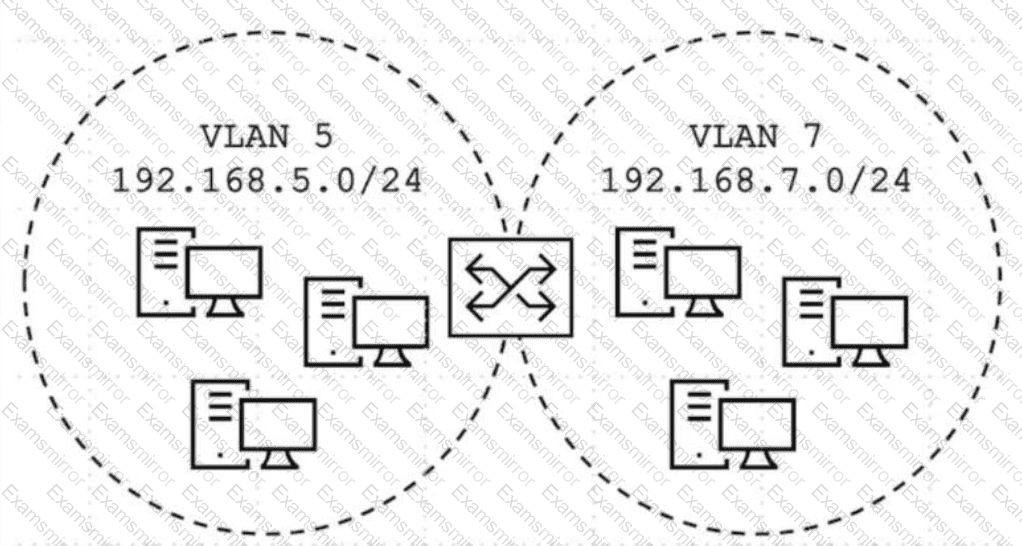
Devices on VLAN 5 and VLAN 7 need to communicate with each other.

Referring to the exhibit, what will satisfy this requirement?

Options:

A.

Configure a family inet interface connecting the two VLANs and assign both subnet IPs to it using secondary addressing.

B.

Enable spanning tree on both VLANs and set the EX Series Switch as the root bridge.

C.

Add both VLANs to a single trunk port and enable the Multiple VLAN Registration Protocol.

D.

Create an integrated routing and bridging (IRB) interface for each VLAN, assign the gateway IP to each IRB, and enable static routing.

Questions # 8:

[Exhibit]

Question # 8

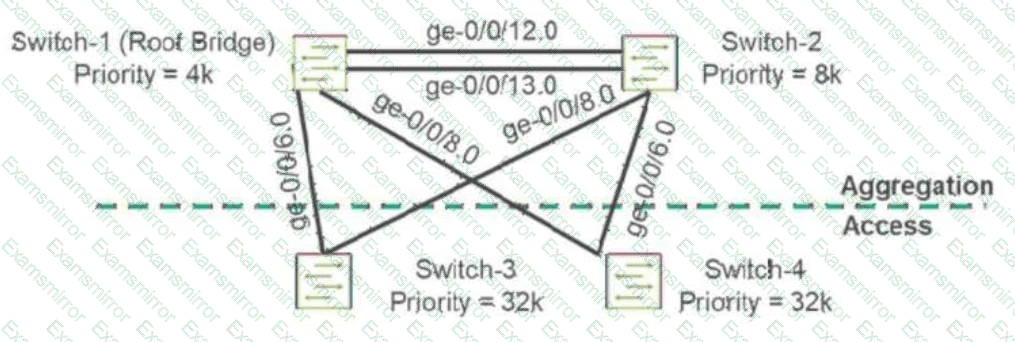
Click the Exhibit button.

You are asked to ensure that there will not be any unwanted STP topology changes affecting your root bridge placement because a rogue switch was introduced into the network at the access layer.

Referring to the exhibit, which interfaces will need to have root protection applied to accomplish this task?

Options:

A.

Place root protection on ge-0/0/6 and ge-0/0/8 on Switch-1 only.

B.

Place root protection on ge-0/0/6 and ge-0/0/8 on Switch-3 and Switch-4.

C.

Place root protection on ge-0/0/6 and ge-0/0/8 on Switch-1 and Switch-2.

D.

Place root protection on ge-0/0/12 and ge-0/0/13 on Switch-1 and Switch-2.

Questions # 9:

You are establishing a new BGP session to an EBGP peer using loopback addresses.

In addition to your general EBGP settings, which BGP feature must be enabled for this session to establish?

Options:

A.

multihop

B.

multipath

C.

damping

D.

passive

Questions # 10:

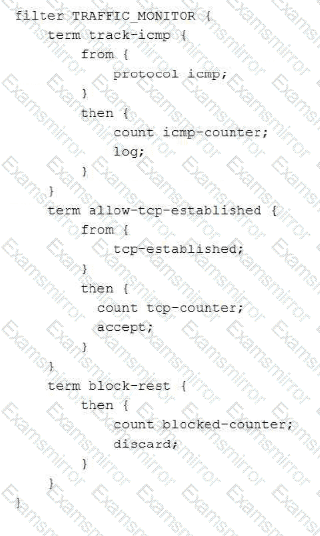
Refer to Exhibit:

Question # 10

You have applied a firewall filter as an ingress filter on the ge-0/0/0 interface of your Juniper Networks EX Series Switch as shown in the exhibit. An external host sends an ICMP ping packet to the router.

Which statement is correct about how this packet is processed?

Options:

A.

The icmp-counter and blocked-counter are both incremented and the packet is dropped.

B.

The icmp-counter is incremented and the packet is dropped.

C.

The icmp-counter is incremented and the packet is accepted.

D.

The icmp-counter and tcp-counter are both incremented and the packet is accepted.

Viewing page 1 out of 2 pages
Viewing questions 1-10 out of questions
TOP CODES

TOP CODES

Top selling exam codes in the certification world, popular, in demand and updated to help you pass on the first try.