
Pre-Summer Special Limited Time 70% Discount Offer - Ends in 0d 00h 00m 00s - Coupon code = getmirror

Pass the NBRC Certification RPFT Questions and answers with ExamsMirror

Practice at least 50% of the questions to maximize your chances of passing.
Exam RPFT Premium Access

View all detail and faqs for the RPFT exam


873 Students Passed

94% Average Score

95% Same Questions
Viewing page 2 out of 4 pages
Viewing questions 11-20 out of questions
Questions # 11:

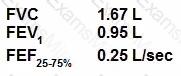
A 66-year-old female performs spirometry with the following results:
Question # 11

The patient most likely has

Options:

A.

Normal pulmonary function.

B.

Obstructive lung disease.

C.

Restrictive lung disease.

D.

Pulmonary hypertension.

Questions # 12:

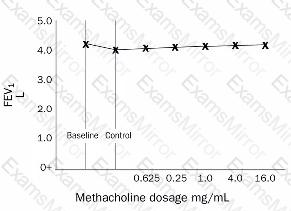
The following data were obtained from a bronchial challenge test:
Question # 12

APC20of 2 mg/mL was obtained the next day in another laboratory. Which of the following is the most likely explanation for these data?

Options:

A.

The two test results are within day-to-day variability.

B.

Incorrect doses of methacholine were administered.

C.

The spirometer accuracy drifted during the test.

D.

The patient's effort was inconsistent.

Questions # 13:

The following biologic control data ranges were established:

The following additional data were obtained when assessing the equipment:

Which of the following should a pulmonary function technologist do?

Options:

A.

Change the CO2and H2O absorbers.

B.

Continue testing patients.

C.

Change the DLcoCO analyzer.

D.

Check the flow sensor.

Questions # 14:

Results of two blood gas samples drawn from the same patient, 30 minutes apart, are shown below:

Which of the following is the most likely explanation for these differences?

Options:

A.

The patient's minute ventilation has increased.

B.

The patient has developed a pneumothorax.

C.

The 10:30 blood sample has been contaminated with air.

D.

The 10:30 blood sample contains an excess of heparin solution.

Questions # 15:

A body plethysmograph box pressure transducer fails the electronic calibration check after multiple attempts. Which of the following should a pulmonary function technologist do?

1. Perform a biologic control test

2. Inspect the door seal.

3. Re-zero the box pressure transducer.

4. Perform a physical pressure calibration.

Options:

A.

1, 2, and 4 only

B.

1, 3, and 4 only

C.

2, 3, and 4 only

D.

1, 2, and 3 only

Questions # 16:

To check the reliability of a pulse oximeter reading, a pulmonary function technologist should

Options:

A.

Calculate the SaO2from pH and PaO2

B.

Perform hemoximetry

C.

Measure the hematocrit

D.

Have the patient hyperventilate

Questions # 17:

A biologic control subject has a FRCplethof 4.0 ±0.3 L at panting frequencies between 60 and 70/min. During a QC run, the subject pants at55/min and a FRCplethof 3.90 L is recorded.

Which of the following is the most appropriate action to take?

Options:

A.

Recalibrate the mouth pressure transducer and repeat the test.

B.

Repeat the test, coaching the subject to pant more slowly.

C.

Continue using the system because it is within control limits.

D.

Take the plethysmograph out of service pending corrective maintenance.

Questions # 18:

Airways resistance and specific conductance tests are requested for a 7-year-old child with asthma. Which of the following techniques is preferred?

Options:

A.

Panting with body plethysmography

B.

Quiet breathing with body plethysmography

C.

Interrupter

D.

Oscillation

Questions # 19:

While assessing a patient's expired gases at rest prior to exercise, a pulmonary function technologist calculates the RER as 0.6. Which of the following is the most likely explanation?

Options:

A.

The patient has an elevated VDAVT

B.

A gas analyzer is malfunctioning

C.

The expired gas is contaminated with air

D.

The patient is hyperventilating

Questions # 20:

The normal response to an increasing PaCO2is

Options:

A.

To maintain a constant VEuntil the PaCO2exceeds 55 torr.

B.

A decrease in VEof 2to5L/min/torrPCO2.

C.

An increase in VEof 1 to 6 L/min/torr PCO2.

D.

An increase in VEof 10to15L/min/torrPCO2.

Viewing page 2 out of 4 pages
Viewing questions 11-20 out of questions
TOP CODES

TOP CODES

Top selling exam codes in the certification world, popular, in demand and updated to help you pass on the first try.