
Halloween Sale Special Limited Time 75% Discount Offer - Ends in 0d 00h 00m 00s - Coupon code = drift75
Pass the NBRC Pulmonary Function Technology (PFT) RPFT Questions and answers with ExamsMirror
Exam RPFT Premium Access
View all detail and faqs for the RPFT exam
831 Students Passed
89% Average Score
97% Same Questions
To assure linearity of an oxygen analyzer, calibrate with
The following Levy-Jennings charts of control values are obtained:
Which of the following is the correct sequence of actions for a pulmonary function technologist to take?
1. Replace the oxygen electrode.
2. Check the temperature of the measuring chamber.
3. Run protein remover through the blood gas analyzer.
4. Replace the CO2electrode.
During a cardiopulmonary stress test using breath-by-breath gas analysis, a pulmonary function technologist notices that the VO2suddenly decreases. Which of the following may explain this change?
1. The patient has achieved anaerobic threshold.
2. The measurement of the expired gas volumes is inaccurate.
3. O2analyzer "phase delay" has increased.
4. There is a leak in the tubing or mouthpiece.
A 6-year-old child has a history of repeated episodes of wheezing and shortness of breath. A pulmonary function technologist has difficulty obtaining repeatable spirometry results. Which of the following tests should be performed next?
In a patient with neuromuscular disease, which of the following is the best way to detect airway obstruction?
A helium dilution test has just been performed on a patient. The following results are obtained:
FRC 5.0 L
VC 4.0 L
ERV 1.5 L
TLC was calculated to be 6.0 L by plethysmography. From this information, a pulmonary function technologist should conclude that the patient
During a forced vital capacity (FVC) maneuver, a patient produces an exhalation with a slow start and delayed peak expiratory flow. Which of the following is the most probable cause of this pattern?
A smoking cessation program using a nicotine patch is started for all smokers in a factory. Results revealed that smokers who reported they had quit had exhaled carbon monoxide levels less than 6 ppm. A pulmonary function technologist should conclude that
A pulmonary function technologist reviews the following home monitoring spirometry results:
According to National Asthma Education and Prevention Program (NAEPP) guidelines, what feedback should the technologist give to the patient regarding test performance?
A 54-year-old male who smokes presents to the pulmonary laboratory for chronic cough and dyspnea on exertion. PFT and blood gas results show the following:
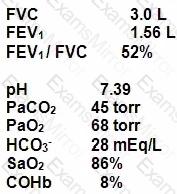
Which of the following should the pulmonary function technologist recommend?

TOP CODES
Top selling exam codes in the certification world, popular, in demand and updated to help you pass on the first try.