
Pre-Summer Special Limited Time 70% Discount Offer - Ends in 0d 00h 00m 00s - Coupon code = getmirror
Pass the NREMT Medical Technicians EMT Questions and answers with ExamsMirror
Exam EMT Premium Access
View all detail and faqs for the EMT exam
800 Students Passed
85% Average Score
92% Same Questions
The acronym HIPAA stands for:
A 10-year-old patient has a closed angulated deformity of the right leg after falling out of a tree. What action should the EMT take first?
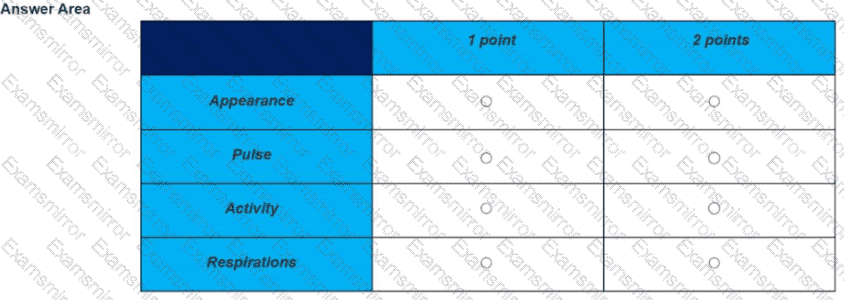
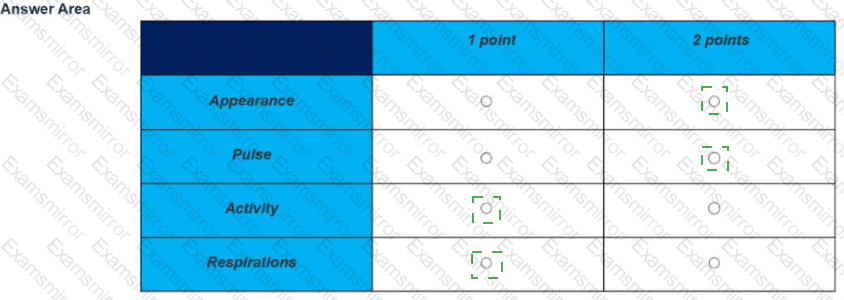
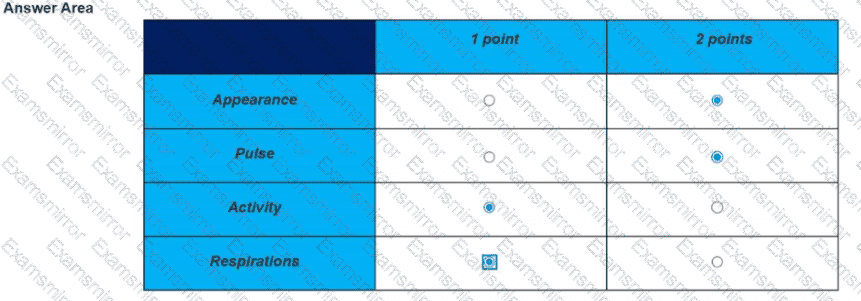
An EMT has just assisted with the delivery of a newborn. At the five-minute mark, the neonate is completely pink with a pulse of 108/min. The neonate has some flexion of their extremities, but the breathing is still slow. How should the EMT score the following categories of the APGAR scale? Select the correct value for each sign.
A 60-year-old patient has crushing, midsternal chest pain that began about 5 minutes ago with exercise. The patient has no prescription medications. The vital signs are BP 142/102 mmHg, P 90/min, R 16/min, and SpO₂ 95% on room air. What treatments should the EMT provide? Select the two answer options that are correct.
An 83-year-old patient is unresponsive and lying on the floor. The patient has a large bruise and laceration on the forehead. The patient’s vital signs are BP 90/60 mmHg, P 126/min, and R 0. Which of the following conditions should the EMT most suspect?
A 50-year-old patient has pain in the right calf. The patient describes the pain as cramping and soreness. The right calf is red, warm to the touch, and noticeably larger than the left calf. The patient’s signs and symptoms are most likely caused by which of the following conditions?
Which of the following would potentially complicate patient care during a helicopter transport?
You have achieved ROSC in a 77-year-old female. She remains unresponsive and her vital signs are BP 94/58, P 82, and R 18. In what position should she be placed?
A person grabs your arm during an argument. This is considered
A 26-year-old patient is 26 weeks pregnant and has severe abdominal pain after being involved in a motor vehicle collision. There is minimal vaginal bleeding, and uterine contractions are present. What condition should the EMT suspect as the most likely cause of the patient ' s signs and symptoms?

TOP CODES
Top selling exam codes in the certification world, popular, in demand and updated to help you pass on the first try.