
Summer Certification Limited Time 70% Discount Offer - Ends in 0d 00h 00m 00s - Coupon code = getmirror
Pass the PECB ISO 14001 ISO-14001-Lead-Auditor Questions and answers with ExamsMirror
Exam ISO-14001-Lead-Auditor Premium Access
View all detail and faqs for the ISO-14001-Lead-Auditor exam
814 Students Passed
89% Average Score
93% Same Questions
Whistlekleen is a national dry cleaning and laundry organisation with 50 shops. You are conducting an EMS surveillance audit of Head Office and are sampling environmental performance measurement. You find that 80 per cent of failures to meet performance criteria originate from five shops in the same region. Most of these failures relate to the release of volatile organic compounds (VOCs) that exceeds regulations. The Environmental Manager tells you that these are the oldest shops in the organisation. The cleaning equipment needs replacing but the organisation cannot afford it at the moment.
On raising the matter with senior management, you are told that there are plans to replace the equipment in these shops over the next five years.
Select two options that apply to how you should respond to the information given.
You are conducting a Stage 2 certification audit of VitalSpark, a pharmaceutical organisation manufacturing vitamins and other healthcare medicines.
In a separate area in the centre of their large site, a supplier produces oxygen supplies piped directly into the manufacturing processes of VitalSpark. They also deliver oxygen in bulk tankers to other customers. When you review the environmental aspects register, you find that the only environmental aspect recorded for this arrangement relates to the heavy goods vehicles of the supplier transiting the site.
You ask the EMS Manager about the environmental consequences to VitalSpark of this arrangement and are told that they are not significant since the supplier has its own services for water, sewage, waste and energy. The EMS Manager tried unsuccessfully to communicate with the supplier who is located inside the VitalSpark site and outside the scope of the EMS.
After gathering more evidence, you note down findings against several clauses of ISO 14001. Determine which three of the findings stated are non-conformities.
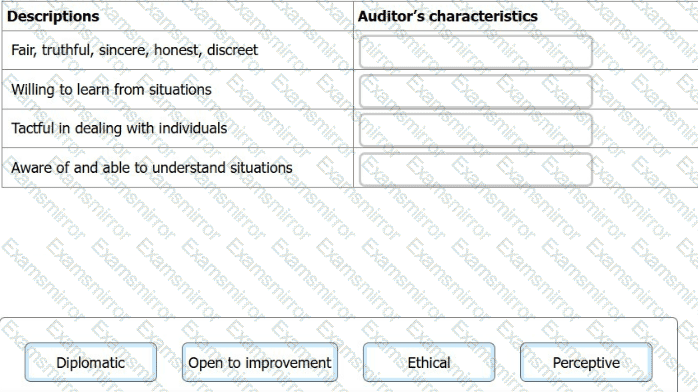
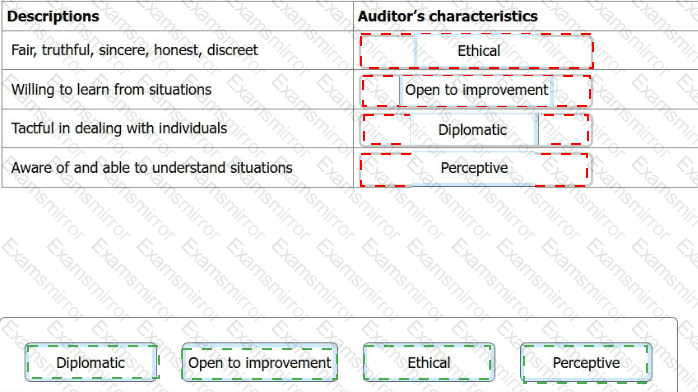
Auditors need to communicate effectively with auditees. Therefore, their personal behaviour is a key characteristic in ensuring a successful audit.
Below is a list of these characteristics and a brief related description. Match the characteristics to the descriptions.
You are a third-party auditor of XM, a logistics organisation located in a European country, that distributes a wide range of products to local customers but also to customers in several neighbouring countries. Close to the distribution warehouse, you see many trucks loading and unloading goods. Almost 50 per cent of the trucks are owned by XM, the remainder are subcontracted from other organisations.
You have the following dialogue with the Warehouse Manager:
You: I see that not all trucks belong to XM.
WM: Sometimes we need additional trucks from other organisations nearby. Obviously, we cannot control their energy consumption since they come with the trucks half full of their own goods.
You: How did you inform them of the EMS?
WM: You know, they are not used to the complicated words in our policy. I have just told them: “Save energy”.
You: What about your trucks?
WM: We measure the fuel they used on each trip, the distance they drove and the weight of goods they distributed. They know the roads and we ask them to choose the shortest route — we rely on them.
You: Did you fix any indicators and objectives related to energy consumption?
WM: No, we know they are careful people, they do their best. We would not be able to improve consumption.
This dialogue is related to several clauses of ISO 14001. Identify which three clauses below are related to this dialogue.
An organisation has the following environmental policy document displayed in the reception area:
" This organisation is committed to providing electric cables to customers ' requirements, in accordance with environmental regulations for their manufacture, use and disposal. The organisation will strive to increase the environmental awareness of its personnel, suppliers, subcontractors and interested parties. Continual environmental improvement is a permanent objective of the organisation. This policy shall be communicated to all employees with the opportunity for them to seek clarification where required. Where required the policy shall be communicated to all interested parties. "
Referring to the above policy statement, select three options for which the organisation is meeting ISO 14001 requirements.
Showitoff is an organisation specialising in the design and production of wall decorating materials for the domestic market. During an ISO 14001 certification audit of the site, the auditor comes across an open, walled area just outside the maintenance department. It contains various scraps of wood and metal as well as several rusty components. They are lying on an oily floor. When asked about it, the EMS Manager states that he presumes that the materials come from maintenance work.
The auditor interviews the Maintenance Manager in his department. He notes that shelves containing various spares are well labelled and neatly stacked. He asked about the " dump " outside and is told that it contains some excess materials that the Manager likes to keep in case they come in handy at some stage. The auditor points out that the " dump " might be classed under regulations as a landfill site, which requires an operating licence. The Maintenance Manager is not aware of such a licence.
Which three statements represent good audit practice?
The following statements are related to audit methods. Review each one and select the two that are true:
You are conducting a Stage 2 certification audit of VitalSpark, a pharmaceutical organisation manufacturing vitamins and other healthcare medicines.
In a separate area in the centre of their large site, a supplier produces oxygen supplies piped directly into the manufacturing processes of VitalSpark. They also deliver oxygen in bulk tankers to other customers. When you review the environmental aspects register, you find that the only environmental aspect recorded for this arrangement relates to the heavy goods vehicles of the supplier transiting the site.
You ask the EMS Manager about the environmental consequences to VitalSpark of this arrangement and are told that they are not significant since the supplier has its own services for water, sewage, waste and energy. The EMS Manager tried unsuccessfully to communicate with the supplier who is located inside the VitalSpark site and outside the scope of the EMS.
After gathering more evidence, you note down findings against several clauses of ISO 14001. Determine which three of the findings stated are non-conformities.
When an organisation needs to determine the resources required for the internal audit programme, which one of the following issues does not impact on the achievement of its intended results?
A small services organisation has been contracted to handle the disposal of waste for a local hospital. You are an auditor conducting a Stage 2 audit of the care home to ISO 14001. You are reviewing the contract with the Service Manager (SM). An addendum to the contract only requires that biological waste is disposed of in the most environmentally friendly way, without reference to any regulatory requirements.
You: How was the waste disposal plan for the contract developed?
SM: We have a basic template that covers the materials, labour requirements and methods to be employed. Some of that is specified by the contractor.
You: How does the plan deal with specific items like biological waste, which are included in the contract and can pose biological hazards to the environment?
SM: The basic plan covers general waste, but we have an addendum that covers biological waste.
You: Are you aware of the regulatory requirements for waste disposal standards in hospitals?
SM: Yes but we depend on the contractor to look after that side of things.
You raise a nonconformity against section 8.1.d of ISO 14001.
At the Stage 2 closing meeting of the audit, the EMS Manager objects to the nonconformity raised and asks for it to be withdrawn. He insists that they meet all the regulations.
Choose one of the options that the audit team leader should take in response to the request.

TOP CODES
Top selling exam codes in the certification world, popular, in demand and updated to help you pass on the first try.