
Halloween Sale Special Limited Time 75% Discount Offer - Ends in 0d 00h 00m 00s - Coupon code = drift75
Pass the PRMIA PRM Certification 8010 Questions and answers with ExamsMirror
Exam 8010 Premium Access
View all detail and faqs for the 8010 exam
807 Students Passed
86% Average Score
90% Same Questions
The Basel framework does not permit which of the following Units of Measure (UoM) for operational risk modeling:
I. UoM based on legal entity
II. UoM based on event type
III. UoM based on geography
IV. UoM based on line of business
Which of the following decisions need to be made as part of laying down a system for calculating VaR:
I. How returns are calculated, eg absoluted returns, log returns or relative/percentage returns
II. Whether VaR is calculated based on historical simulation, Monte Carlo, or is computed parametrically
III. Whether binary/digital options are included in the portfolio positions
IV. How volatility is estimated
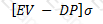
If EV be the expected value of a firm's assets in a year, and DP be the 'default point' per the KMV approach to credit risk, and σ be the standard deviation of future asset returns, then the distance-to-default is given by:
A)

B)

C)
D)

The Options Theoretic approach to calculating economic capital considers the value of capital as being equivalent to a call option with a strike price equal to:
Which of the following losses can be attributed to credit risk:
I. Losses in a bond's value from a credit downgrade
II. Losses in a bond's value from an increase in bond yields
III. Losses arising from a bond issuer'sdefault
IV. Losses from an increase in corporate bond spreads
Which of the following decisions need to be made as part of laying down a system for calculating VaR:
I. The confidence level and horizon
II. Whether portfolio valuation is based upon a delta-gamma approximation or a full revaluation
III. Whether the VaR is to be disclosed in the quarterly financial statements
IV. Whether a 10 day VaR will be calculated based on 10-day return periods, or for 1-day and scaled to 10 days
If the default hazard rate for a company is 10%, and the spread on its bondsover the risk free rate is 800 bps, what is the expected recovery rate?
Identify the correct sequence of events as it unfolded in the credit crisis beginning 2007:
I. Mortgage defaults increased
II. Collapse in prices of unrelated assets as banks tried to create liquidity
III. Banks refused to lend or transact with each other
IV. Asset prices for CDOs collapsed
A stock that follows the Weiner process has its future price determined by:
When fitting a distribution in excess of a threshold as part of the body-tail distribution method described by the equation below, how is the parameter 'p' calculated.

Here, F(x) is the severity distribution. F(Tail) and F(Body) are the parametric distributions selected for the tail and the body, and T is the threshold in excess of which the tail is considered to begin.

TOP CODES
Top selling exam codes in the certification world, popular, in demand and updated to help you pass on the first try.