
Pre-Winter Sale Limited Time 70% Discount Offer - Ends in 0d 00h 00m 00s - Coupon code = getmirror
Pass the Splunk Cybersecurity Defense Analyst SPLK-5002 Questions and answers with ExamsMirror
Exam SPLK-5002 Premium Access
View all detail and faqs for the SPLK-5002 exam
762 Students Passed
84% Average Score
94% Same Questions
An engineer has been working on building a new automation for the SOC. What Scope should be selected in the SOAR Playbook Debugger during the playbook development to ensure consistency?
Which of the following identifies elements of the Detection Development Lifecycle (DDLC)?
MITRE D3FEND is designed to compliment MITRE ' s list of adversarial tactics, techniques, and common knowledge (ATT & CK). Which tactics are associated with MITRE D3FEND in order to detect, deny, and disrupt adversarial efforts?
In order to perform a complete data assessment, an engineer ' s role within Splunk must have which of the following?
Which practices strengthen the development of Standard Operating Procedures (SOPs)? (Choose three)
The following SPL is designed to report on a certain SOC metric. Which metric is the most likely topic for this report?
| tstats summariesonly=true earliest(_time) as _time
FROM datamodel=Incident_Management
BY " Notable_Events.Meta.rule_id "
| rename " Notable_Events.Meta.* " as " * "
| lookup update=true incident_updates_lookup rule_id OUTPUTNEW time
| search time=*
| stats earliest(_time) as create_time, min(time) as triage_time by rule_id
| eval diff=triage_time-create_time,
stat_type=if(
create_time < relative_time(now(), " -7d@d " ),
" past " ,
" current "
),
past=if(stat_type= " past " , 1, 0),
current=if(stat_type= " current " , 1, 0),
past_diff=if(stat_type= " past " , diff, 0),
current_diff=if(stat_type= " current " , diff, 0)
| stats sum(past) AS past,
sum(current) AS current,
sum(past_diff) AS past_diff,
sum(current_diff) AS current_diff
| eval past=round(past_diff/past/60),
current=round(current_diff/current/60)
| table past, current
| transpose
An automation engineer for the Wonderland SOC has configured a new asset and is getting an HTTP 403 response code. Which of the following is a possible cause of the error code?
Which fields are used to determine asset priority, when priority is assigned through an asset and identity lookup?
What is Enterprise Security ' s default way of determining the urgency of a finding (notable event)?
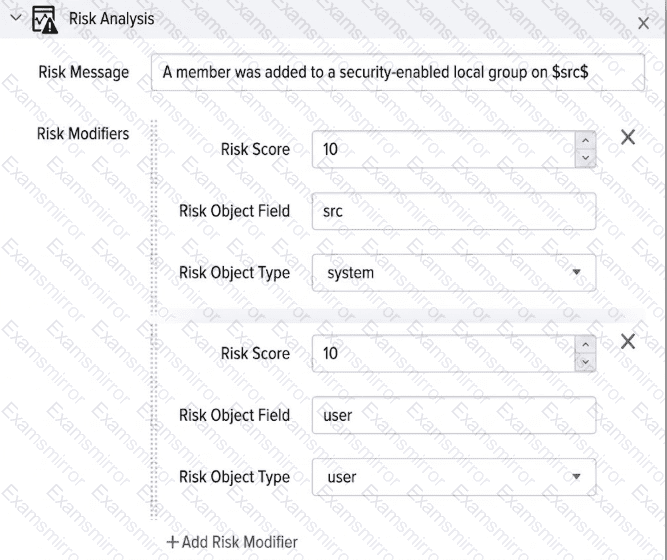
Based on this example image, if it is detected that a member has been added to a security-enabled local group, how many risk events will be created?

TOP CODES
Top selling exam codes in the certification world, popular, in demand and updated to help you pass on the first try.