
Summer Certification Limited Time 70% Discount Offer - Ends in 0d 00h 00m 00s - Coupon code = getmirror
Pass the VMware VCAP-Storage 3V0-23.25 Questions and answers with ExamsMirror
Exam 3V0-23.25 Premium Access
View all detail and faqs for the 3V0-23.25 exam
584 Students Passed
90% Average Score
90% Same Questions
A customer attaches an external Fibre Channel (FC) VMFS datastore to a VMware Cloud Foundation (VCF) workload domain for backup staging. The administrator must confirm that the datastore is visible to all hosts, and that path and device health alarms will trigger should a fabric link or path fail.
Which action should the administrator take to verify this?
An administrator is managing a local vSAN 3-node cluster running the Express Storage Architecture (ESA) as part of a VMware
Cloud Foundation (VCF) Workload Domain.
The following parameters apply at the cluster level:
• HA is enabled
• Reserved Failover Capacity = 25% for both CPU and Memory
The administrator is tasked with configuring the VSAN storage policy so it will tolerate the maximum number of failures.
What two protection levels can the administrator configure? (Choose two.)
An administrator is tasked with designing a highly available vSAN ESA two-node cluster for a remote VMware Cloud Foundation (VCF) workload domain. The solution should be able to survive the failure of any disk group in addition to a host failure without data loss.
What is the minimum total number of nested fault domains required for the design?
The Windows team is planning to deploy a Windows Server Failover Cluster. This requires a disk shared between all members of the cluster.
Which two options are available to fulfill this requirement on a vSAN ESA cluster? (Choose two.)
An administrator has been tasked with suggesting storage models for a new VMware Cloud Foundation (VCF) Private Cloud with the following characteristics:
• Single VCF Instance with a single Workload Domain.
• The VCF Management Workload Domain will consist of a single cluster that uses a highly scalable, integrated storage solution that does not require additional management software or hardware.
• The VCF Workload Domain consists of a single Cluster that requires a multiple-tier storage solution consisting of:
A highly scalable, policy-based storage solution for critical application workloads.
A file-based storage solution that can scale independently of the cluster for workloads with large data requirements. Which three storage models should the administrator recommend? (Choose three.)
An administrator reports that after rebooting one host in a vSAN cluster configured with Data-at-Rest Encryption using an external Key Management Server (KMS), the host shows all vSAN disk groups as unmounted.
The KMS is online and reachable from all hosts.
In vCenter, the host displays the following event:
“Failed to retrieve encryption key from KMS.”
Key ID:
All other hosts in the cluster remain healthy and show “Encryption: Enabled.”
Why did the encryption key retrieval fail for this host?
While creating a recovery plan that matches the business continuity plan, an administrator needs to add custom steps to the recovery plan.
Which three custom steps are available? (Choose three.)
An administrator is planning the deployment of a new VMware Cloud Foundation (VCF) Workload Domain. The storage design decisions for the solution are:
• NFS
• NVMe over RDMA
• No local storage is available to the hosts
What is the storage solution build order for the Workload Domain?
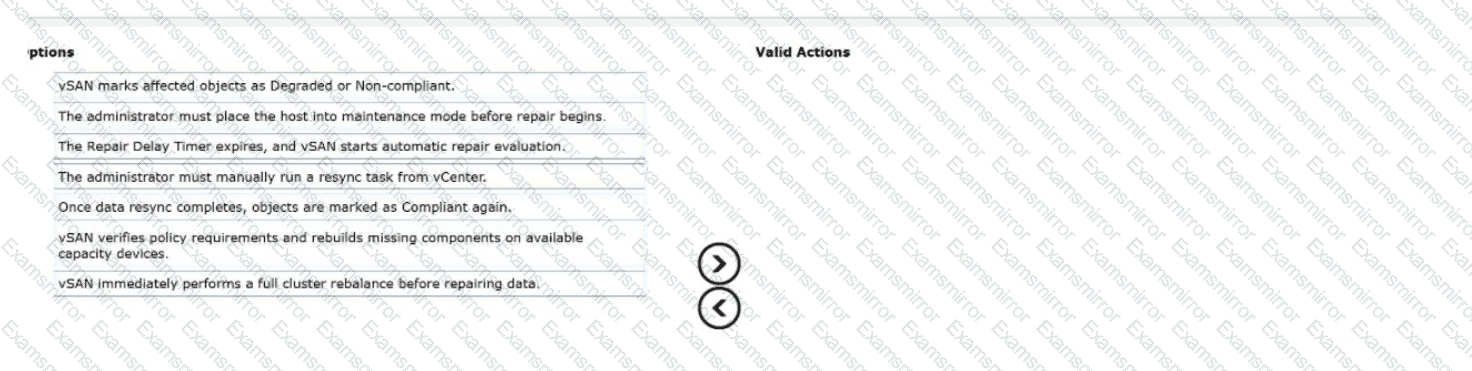
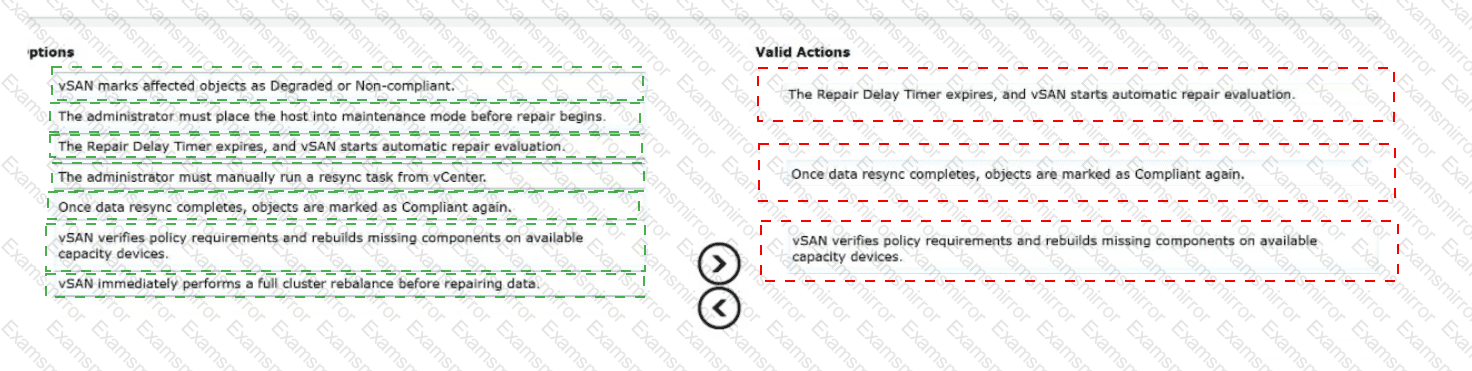
In a vSAN ESA cluster, one host goes offline unexpectedly for more than an hour.
When it returns online, vSAN needs to rebuild and restore compliance for several objects that became degraded during the outage.
Drag and drop the three correct options for the automatic recovery process from the Options list on the left and place them into the Valid Actions on the right in any order. (Choose three.)
An architect is designing a vSAN storage solution for a remote site. The following requirements have been given:
• There is enough rack space for two hosts, each with 36 CPU cores and 256 GB of RAM.
• The physical network at the remote site supports 10 Gb maximum.
• The network connecting the remote site to corporate has 10 Gb of bandwidth with an average RTT of 25 ms.
• High availability is expected for all the Virtual Machines running at the remote site.
• The solution must provide additional storage to 16 graphic design Windows based workstations.
• Active Directory is configured and available at the remote site.
• The graphic design application requires native NTFS permissions.
What vSAN advanced technology is required for configuring this remote site?

TOP CODES
Top selling exam codes in the certification world, popular, in demand and updated to help you pass on the first try.