
Weekend Sale Special Limited Time 75% Discount Offer - Ends in 0d 00h 00m 00s - Coupon code = drift75
Pass the GAQM Lean Six Sigma Black Belt Certification CLSSBB Questions and answers with ExamsMirror
Exam CLSSBB Premium Access
View all detail and faqs for the CLSSBB exam
691 Students Passed
87% Average Score
93% Same Questions
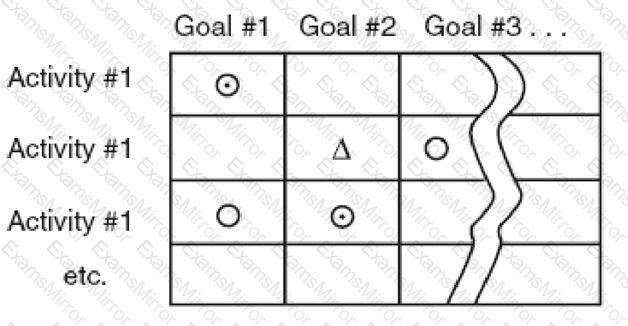
A management team lists nine goals across the top of a rectangle and 15 activity initiatives along the left hand side of the rectangle. If one of the activities strongly supports one of the goals a circle is placed in the box where that activity’s row intersects the goal’s column. If the activity’s support is very strong a “bulls eye” is placed in the box and if the support is weak a triangle is used.
This best describes which problem solving tool?
A quality leader who did extensive work with Japanese industry is:
After a team has engaged in diversion activities they may need to employ a tool for conversion. Examples of such a tool are:
I. nominal group technique
II. Multivoting
III. cause and effect diagram
IV. activity network diagram
V. matrix diagrams
SCENARIO
A Six Sigma team is measuring the moisture content of corn starch as it leaves the conveyer belt of a dryer. They collect one sample four cups of starch at times indicated in the chart at fixed locations labeled A, B, C, and D across the end of the belt. See the diagram below.
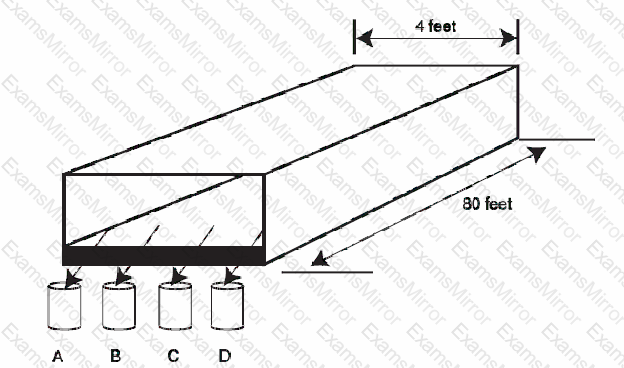
After some work on the dryer, additional data are collected which when plotted looks like this:
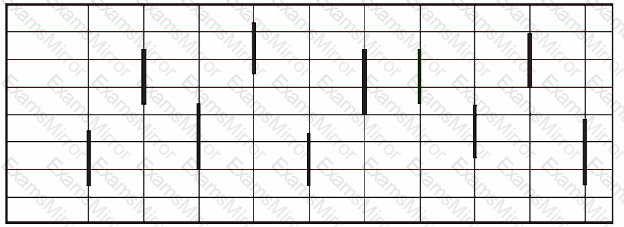
Which type of variation dominates?
The principle disadvantage of fractional factorial experiments is that:
A team working with a plant relocation is tasked with designing a process for moving 180 pieces of equipment. Incoming orders may need to be filled during the move at either the old site or the new one. Transportation equipment availability is uncertain. Construction schedules at the new site is very weather dependent. The team designs a chart that attempts to cover these and other contingencies with appropriate measures dealing with each.
The tool best fitted for this task is:
A team studies a coil steel banding process and makes five changes resulting in productivity improvements of 2%, 2.8%, 2.4%, 2% and 3% respectively. These improvements are best described by which approach to problem solving?
A team has been asked to reduce the cycle time for a process. The team decides to collect baseline data. It will do this by:
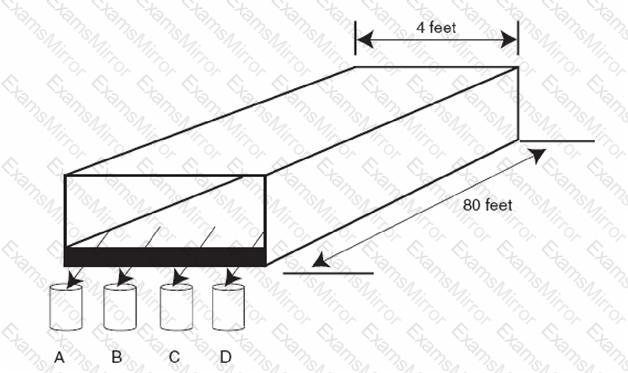
SCENARIO A Six Sigma team is measuring the moisture content of corn starch as it leaves the conveyer belt of a dryer. They collect one sample four cups of starch at times indicated in the chart at fixed locations labeled A, B, C, and D across the end of the belt. See the diagram below.
Find the sample linear correlation coefficient and the sample coefficient of determination for the data in problem VI.11.
(Refer to the previous problem) To estimate the within treatment variance the experimenters would calculate the variances of:

TOP CODES
Top selling exam codes in the certification world, popular, in demand and updated to help you pass on the first try.