
Pre-Winter Sale Limited Time 70% Discount Offer - Ends in 0d 00h 00m 00s - Coupon code = getmirror
Pass the PECB ISO 9001 ISO-9001-Lead-Auditor Questions and answers with ExamsMirror
Exam ISO-9001-Lead-Auditor Premium Access
View all detail and faqs for the ISO-9001-Lead-Auditor exam
735 Students Passed
91% Average Score
96% Same Questions
ISO 9001 addresses changes through several requirements, two examples of which are Clause 6.3 (Planning of Changes) and Clause 8.5.6 (Control of Changes). How do the requirements of Clause 8.5.6 differ from those of Clause 6.3?
Which of the following is a principle of maintaining audit work documents?
You are conducting an audit at a single-site organisation seeking certification to ISO 9001 for the first time. The organisation manufactures cosmetics for major retailers and the name of the retailer supplied appears on the product packaging. Sales turnover has increased significantly over the past five years
You are interviewing the new Product Development Manager. You note that a software application called SWIFT is used to help control the product development process.
You have gathered audit evidence as outlined in the table. Match the ISO 9001 clause 8.3 extracts to the audit evidence.


Which type of audit risk is the risk that a significant defect may occur in the QMS, although the organization has internal control mechanisms in place?
ABC is a fast food shop that receives orders by phone or the internet. The normal menu includes 15 different types of hamburgers; however, in the
last two days, due to a shortage of a special type of meat, they can only prepare six of the 15 varieties.
You are performing a third-party audit of ABC; you observed that the menu offering food on the website is still the normal one, with 15 different
hamburgers. During a 30-minute period, you observed several customers reluctantly accepting other than the hamburger they preferred. You decided
to raise the following nonconformity as follows:
"There is evidence that ABC has not reviewed the ability to provide customers the offered products".
The restaurant manager does not accept the nonconformity. She says that ABC had an extensive training programme for all personnel, which you have already seen when auditing Human Resources. This shortage of some hamburgers cannot be considered a management system failure.
Which one would be your answer from the following options?
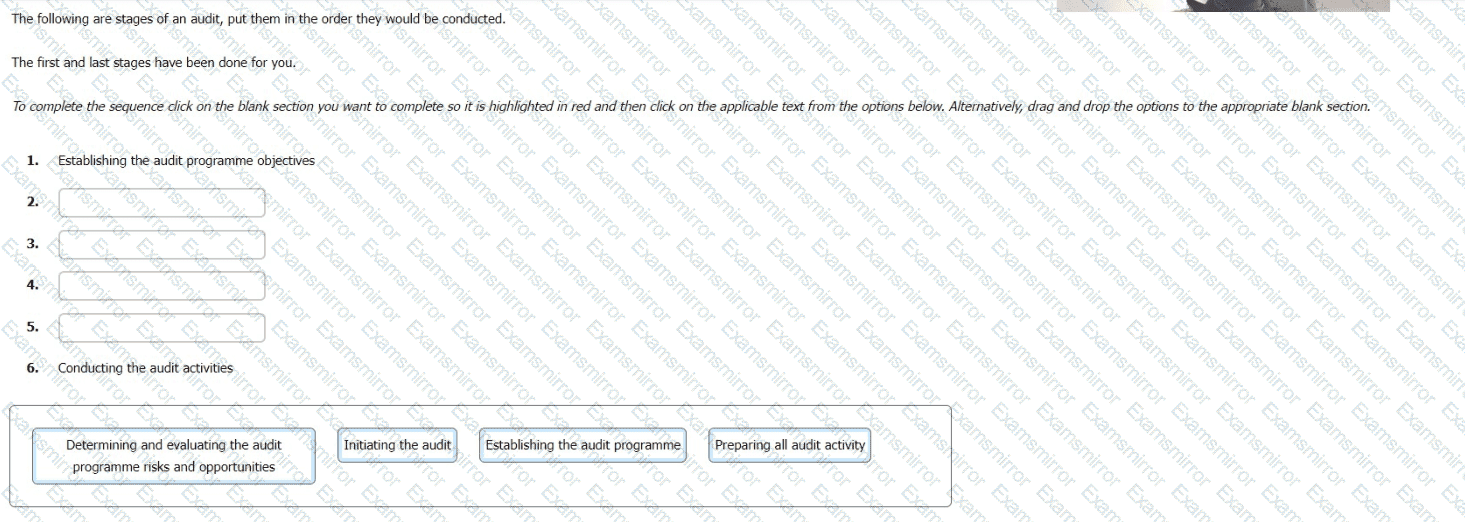
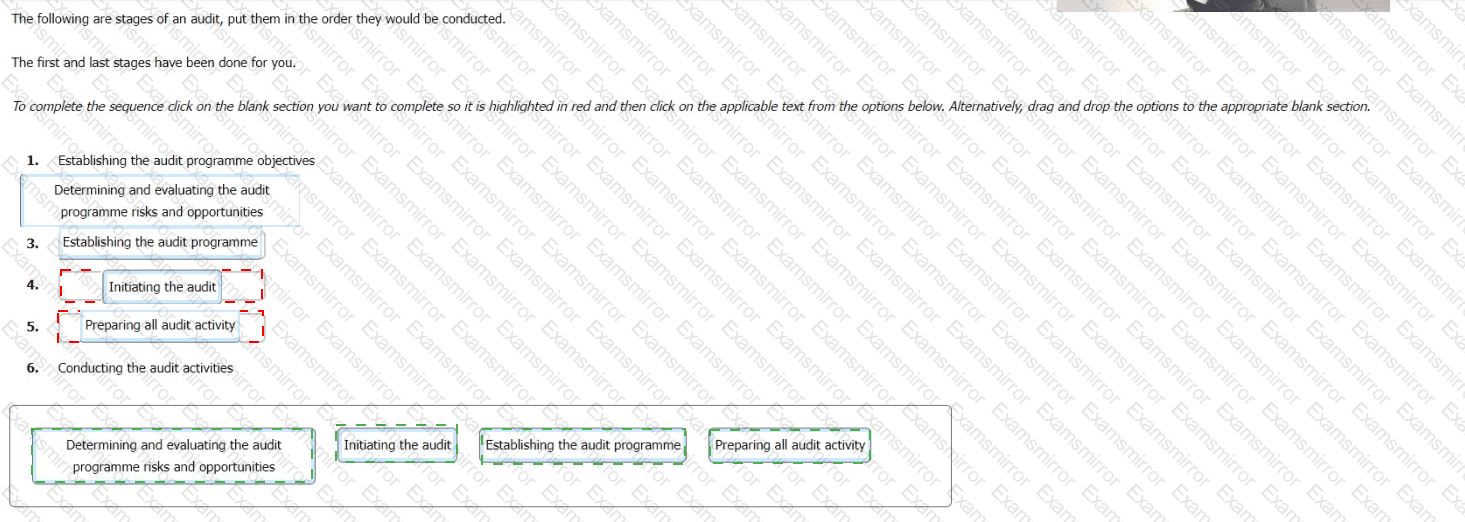
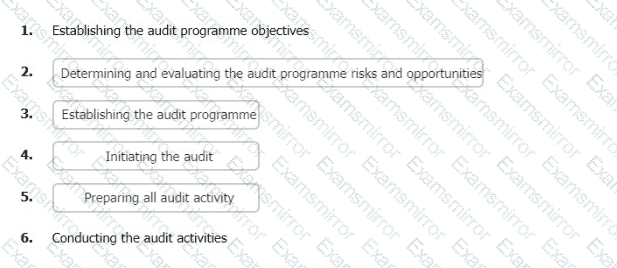
The following are stages of an audit, put them in the order they would be conducted.
You are conducting a Stage 1 audit at an organisation that services refrigeration equipment for a large customer base. The scope of certification is “Provision of refrigeration equipment maintenance and repair services”. You are interviewing the Managing Director to learn more about the organisation and to explore how the requirements for policy, objectives, and risks and opportunities in ISO 9001 are addressed.
The Managing Director explains that they only use sub-contract refrigeration engineers and do not have any full-time refrigeration engineers, which helps to optimise overhead costs. The full-time staff employed are essentially a small team of office staff who process customer enquiries, schedule jobs and process invoices.
The Managing Director adds that the ISO 9001 requirements for competence of personnel extends to both sub-contract and full-time staff. He also states that the full-time staff are aware of the Quality Policy, objectives and plans to address risk and opportunities.
You ask if the sub-contract engineers have been informed of the Quality Policy, objectives and plans to address risks and opportunities, to which the Managing Director replies that this is not applicable as they only use sub-contractors who operate ISO 9001 certificated quality management systems. The documented information provided to the auditor confirms this.
Which clause in ISO 9001 is most likely not to have been fulfilled in this instance?
Scenario 6: Davis Clinic (DC) is an American medical center focused on integrated health care. Since its establishment DC was committed to providing qualitative services for its clients, which is the reason why the company decided to implement a quality management system (QMS) based on ISO 9001. After a year of having an active QMS in place, DC applied for a certification audit.
A team of five auditors, from a well-known certification body, was selected to conduct the audit. Eva was appointed as the audit team leader. After three days of auditing, the team gathered to review and examine their findings. They also discussed the audit findings with DC ' s top management and then drafted the audit conclusions.
In the closing meeting, which was held between the audit team and the top management of DC. Eva presented two nonconformities that were detected during the audit. Eva stated that the company did not retain documented information regarding its outsourced services for an analysis laboratory and regarding the conducted management reviews. During the closing meeting, the audit team required from DCs top management to come up with corrective action plans within two weeks. Although the top management did not agree with the audit findings, the audit team insisted that the auditee must submit corrective actions within the given time frame in order for the audit activities to continue.
Once the action plans were evaluated, the audit team began preparing the audit report. Eva required from the team to provide accurate descriptions of the audit findings and the audit conclusions. The report was then distributed to all the interested parties involved in the audit, including the certification body Based on the report, the certification body together with Eva, as the audit team leader, made the certification decision.
Based on the scenario above, answer the following question:
Is it acceptable for the certification body and Eva to make the certification decision together?
How much time is usually spent on the Stage 1 audit?
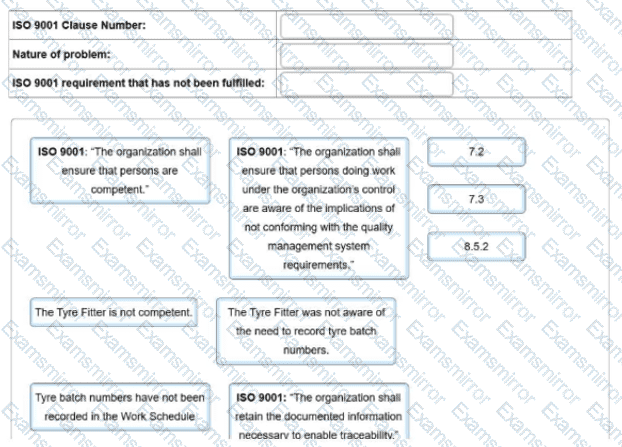
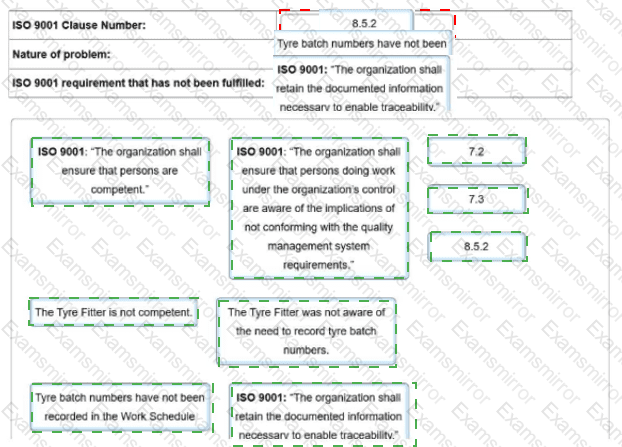
To complete the non-conformity report, click on the blank section you want to complete so it is highlighted in red and then click on the applicable text from the options below. Alternatively, drag and drop the options to the appropriate blank section.

TOP CODES
Top selling exam codes in the certification world, popular, in demand and updated to help you pass on the first try.