Pre-Summer Special Limited Time 70% Discount Offer - Ends in 0d 00h 00m 00s - Coupon code = getmirror

Pass the GAQM Certified Ethical Hacker CEH CEH-001 Questions and answers with ExamsMirror

Practice at least 50% of the questions to maximize your chances of passing.
Exam CEH-001 Premium Access

View all detail and faqs for the CEH-001 exam


796 Students Passed

86% Average Score

93% Same Questions
Viewing page 8 out of 14 pages
Viewing questions 141-160 out of questions
Questions # 141:

Which type of attack is port scanning?

Options:

A.

Web server attack

B.

Information gathering

C.

Unauthorized access

D.

Denial of service attack

Questions # 142:

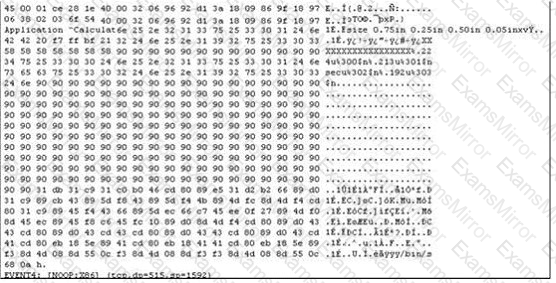
Exhibit:

Question # 142

The following is an entry captured by a network IDS.You are assigned the task of analyzing this entry. You notice the value 0x90, which is the most common NOOP instruction for the Intel processor. You figure that the attacker is attempting a buffer overflow attack. You also notice "/bin/sh" in the ASCII part of the output. As an analyst what would you conclude about the attack?

Options:

A.

The buffer overflow attack has been neutralized by the IDS

B.

The attacker is creating a directory on the compromised machine

C.

The attacker is attempting a buffer overflow attack and has succeeded

D.

The attacker is attempting an exploit that launches a command-line shell

Questions # 143:

Password cracking programs reverse the hashing process to recover passwords.(True/False.

Options:

A.

True

B.

False

Questions # 144:

How can you determine if an LM hash you extracted contains a password that is less than 8 characters long?

Options:

A.

There is no way to tell because a hash cannot be reversed

B.

The right most portion of the hash is always the same

C.

The hash always starts with AB923D

D.

The left most portion of the hash is always the same

E.

A portion of the hash will be all 0's

Questions # 145:

Which of the following is the primary objective of a rootkit?

Options:

A.

It opens a port to provide an unauthorized service

B.

It creates a buffer overflow

C.

It replaces legitimate programs

D.

It provides an undocumented opening in a program

Questions # 146:

Eric has discovered a fantastic package of tools named Dsniff on the Internet. He has learnt to use these tools in his lab and is now ready for real world exploitation. He was able to effectively intercept communications between the two entities and establish credentials with both sides of the connections. The two remote ends of the communication never notice that Eric is relaying the information between the two.

What would you call this attack?

Options:

A.

Interceptor

B.

Man-in-the-middle

C.

ARP Proxy

D.

Poisoning Attack

Questions # 147:

Which of the following Netcat commands would be used to perform a UDP scan of the lower 1024 ports?

Options:

A.

Netcat -h -U

B.

Netcat -hU

C.

Netcat -sU -p 1-1024

D.

Netcat -u -v -w2 1-1024

E.

Netcat -sS -O target/1024

Questions # 148:

What is the algorithm used by LM for Windows2000 SAM?

Options:

A.

MD4

B.

DES

C.

SHA

D.

SSL

Questions # 149:

What hacking attack is challenge/response authentication used to prevent?

Options:

A.

Replay attacks

B.

Scanning attacks

C.

Session hijacking attacks

D.

Password cracking attacks

Questions # 150:

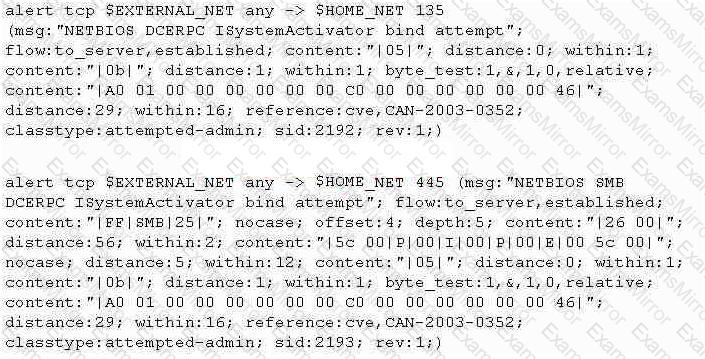
Study the snort rule given below:

Question # 150

From the options below, choose the exploit against which this rule applies.

Options:

A.

WebDav

B.

SQL Slammer

C.

MS Blaster

D.

MyDoom

Questions # 151:

What happens when one experiences a ping of death?

Options:

A.

This is when an IP datagram is received with the “protocol” field in the IP header set to 1 (ICMP) and the “type” field in the ICMP header is set to 18 (Address Mask Reply).

B.

This is when an IP datagram is received with the “protocol” field in the IP header set to 1 (ICMP), the Last Fragment bit is set, and (IP offset ‘ 8) + (IP data length) >65535.

In other words, the IP offset (which represents the starting position of this fragment in the original packet, and which is in 8-byte units) plus the rest of the packet is greater than the maximum size for an IP packet.

C.

This is when an IP datagram is received with the “protocol” field in the IP header set to 1 (ICMP) and the source equal to destination address.

D.

This is when an the IP header is set to 1 (ICMP) and the “type” field in the ICMP header is set to 5 (Redirect).

Questions # 152:

Peter, a Network Administrator, has come to you looking for advice on a tool that would help him perform SNMP enquires over the network. Which of these tools would do the SNMP enumeration he is looking for?

Select the best answers.

Options:

A.

SNMPUtil

B.

SNScan

C.

SNMPScan

D.

Solarwinds IP Network Browser

E.

NMap

Questions # 153:

Eve is spending her day scanning the library computers. She notices that Alice is using a computer whose port 445 is active and listening. Eve uses the ENUM tool to enumerate Alice machine. From the command prompt, she types the following command.

For /f "tokens=1 %%a in (hackfile.txt) do net use * \\10.1.2.3\c$ /user:"Administrator" %%a

What is Eve trying to do?

Options:

A.

Eve is trying to connect as an user with Administrator privileges

B.

Eve is trying to enumerate all users with Administrative privileges

C.

Eve is trying to carry out a password crack for user Administrator

D.

Eve is trying to escalate privilege of the null user to that of Administrator

Questions # 154:

Tess King is using the nslookup command to craft queries to list all DNS information (such as Name Servers, host names, MX records, CNAME records, glue records (delegation for child Domains), zone serial number, TimeToLive (TTL) records, etc) for a Domain. What do you think Tess King is trying to accomplish? Select the best answer.

Options:

A.

A zone harvesting

B.

A zone transfer

C.

A zone update

D.

A zone estimate

Questions # 155:

You suspect that your Windows machine has been compromised with a Trojan virus. When you run anti-virus software it does not pick of the Trojan. Next you run netstat command to look for open ports and you notice a strange port 6666 open.

What is the next step you would do?

Options:

A.

Re-install the operating system.

B.

Re-run anti-virus software.

C.

Install and run Trojan removal software.

D.

Run utility fport and look for the application executable that listens on port 6666.

Questions # 156:

Which of the following keyloggers cannot be detected by anti-virus or anti-spyware products?

Options:

A.

Covert keylogger

B.

Stealth keylogger

C.

Software keylogger

D.

Hardware keylogger

Questions # 157:

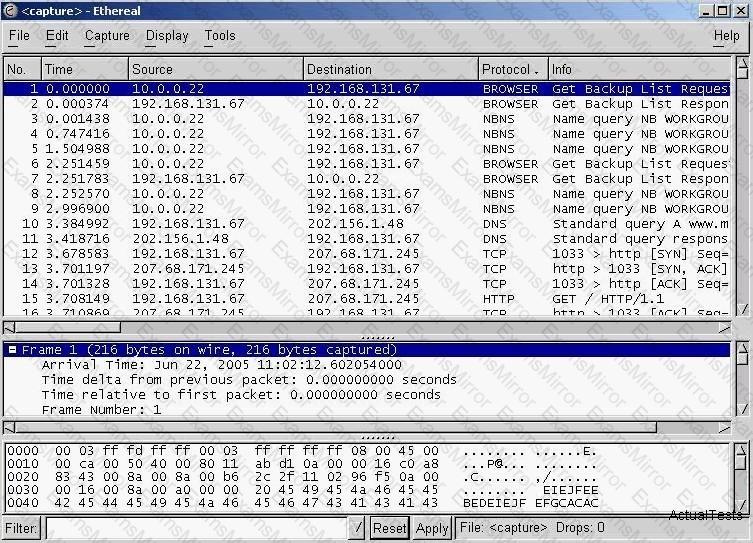
Exhibit:

Question # 157

You have captured some packets in Ethereal. You want to view only packets sent from 10.0.0.22. What filter will you apply?

Options:

A.

ip = 10.0.0.22

B.

ip.src == 10.0.0.22

C.

ip.equals 10.0.0.22

D.

ip.address = 10.0.0.22

Questions # 158:

One of your junior administrator is concerned with Windows LM hashes and password cracking. In your discussion with them, which of the following are true statements that you would point out?

Select the best answers.

Options:

A.

John the Ripper can be used to crack a variety of passwords, but one limitation is that the output doesn't show if the password is upper or lower case.

B.

BY using NTLMV1, you have implemented an effective countermeasure to password cracking.

C.

SYSKEY is an effective countermeasure.

D.

If a Windows LM password is 7 characters or less, the hash will be passed with the following characters, in HEX- 00112233445566778899.

E.

Enforcing Windows complex passwords is an effective countermeasure.

Questions # 159:

Fingerprinting an Operating System helps a cracker because:

Options:

A.

It defines exactly what software you have installed

B.

It opens a security-delayed window based on the port being scanned

C.

It doesn't depend on the patches that have been applied to fix existing security holes

D.

It informs the cracker of which vulnerabilities he may be able to exploit on your system

Questions # 160:

When discussing passwords, what is considered a brute force attack?

Options:

A.

You attempt every single possibility until you exhaust all possible combinations or discover the password

B.

You threaten to use the rubber hose on someone unless they reveal their password

C.

You load a dictionary of words into your cracking program

D.

You create hashes of a large number of words and compare it with the encrypted passwords

E.

You wait until the password expires

Viewing page 8 out of 14 pages
Viewing questions 141-160 out of questions
TOP CODES

TOP CODES

Top selling exam codes in the certification world, popular, in demand and updated to help you pass on the first try.