
Summer Certification Limited Time 70% Discount Offer - Ends in 0d 00h 00m 00s - Coupon code = getmirror

Pass the Huawei HCIP-Datacom H12-821_V1.0 Questions and answers with ExamsMirror

Practice at least 50% of the questions to maximize your chances of passing.
Exam H12-821_V1.0 Premium Access

View all detail and faqs for the H12-821_V1.0 exam


7928 Students Passed

95% Average Score

90% Same Questions
Viewing page 11 out of 12 pages
Viewing questions 101-110 out of questions
Questions # 101:

Four routers run IS-IS and have established adjacencies. The area IDs and router levels are marked in the following figure. R1 and R2 are connected through a PPP link, and R3 is the DIS. Which of the following statements are true?
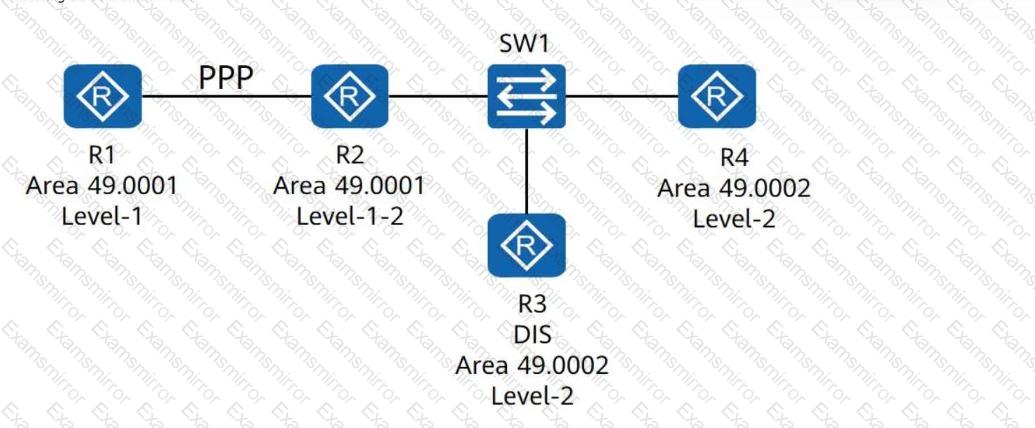
Question # 101

Options:

A.

If R2 sends a Level-2 LSP, R3 needs to send a PSNP for acknowledgment.

B.

R3 periodically sends CSNPs to implement Level-2 LSDB synchronization.

C.

R2 sends an LSP to R3 and R4 in unicast mode.

D.

If R1 sends an LSP, R2 needs to send a PSNP for acknowledgment.

Questions # 102:

ASPF enables the firewall to support multi-channel protocols such as FTP and to define security policies for complex applications.

Options:

A.

TRUE

B.

FALSE

Questions # 103:

Hackers often obtain the login permissions of system administrators through various attacks.

Which of the following measures can be taken to enhance the security of administrator accounts? (Select all that apply)

Options:

A.

Periodically check whether unnecessary administrator accounts exist in the system. If such accounts exist, delete them to reduce the attack surface.

B.

Encrypt passwords before transferring them. Whenever possible, transfer passwords by email.

C.

Assign exclusive accounts for administrators with different maintenance roles to avoid account sharing.

D.

To ensure security and make the password easier to remember, you can set the password to be valid for a long time.

Questions # 104:

In IGMPv1, querier selection depends on a multicast routing protocol, such as PIM. In IGMPv2 and IGMPv3, the interface with the largest IP address acts as the querier.

Options:

A.

TRUE

B.

FALSE

Questions # 105:

Which of the following protocols are multi-channel protocols?

Options:

A.

H.323

B.

FTP

C.

Telnet

D.

SMTP

Questions # 106:

When configuring an ACL on a router, you can specify a unique number or name to identify the ACL. Once a named ACL is created, it cannot be modified. You can only delete the named ACL and reconfigure it.

Options:

A.

TRUE

B.

FALSE

Questions # 107:

After IPsec is deployed on an enterprise network, services are interrupted. The administrator finds that no data flow triggers IKE negotiation.

Which of the following are possible causes? (Select all that apply)

Options:

A.

Configuration error of an interzone security policy

B.

An unreachable route

C.

The IPsec policy is not correctly applied to the related interface.

D.

A mismatch between the ACL and protected data flow

Questions # 108:

A BGP device receives a route carrying an unknown attribute from a peer but does not know whether other devices need the attribute. In this case, the BGP device retains this attribute when advertising the route to other peers. Which of the following attributes is of this type?

Options:

A.

Community

B.

AS.Path

C.

MED

D.

OriginatorID

Questions # 109:

Which of the following statements about stack split is false?

Options:

A.

After a stack splits, the MAC addresses of the two stacks change immediately.

B.

If the master and standby switches are still in the same stack after the stack splits, the slave switches separated from the original master and standby switches re-elect the master and standby switches due to protocol packet timeout.

C.

If the master and standby switches are in two stacks after the split, the stack where the original master switch resides updates the topology and selects a new standby switch. The original standby switch becomes the master switch in the new stack and a new standby switch is elected.

D.

After a stack splits, multiple stacks have the same IP address and MAC address. To prevent network faults, the stacks perform MAD detection. The stack that fails the MAD detection shuts down all physical ports except reserved ports.

Questions # 110:

Which of the following statements about BFD operating modes are true?

Options:

A.

In demand mode, once a BFD session is set up, the system no longer periodically sends BFD Control packets.

B.

Asynchronous mode does not support the Echo function.

C.

In asynchronous mode, two systems periodically exchange BFD Control packets at the negotiated interval. If one system does not receive any BFD Control packets from the other within the detection time, the BFD session is declared down.

D.

Asynchronous mode is the primary BFD operating mode.

Viewing page 11 out of 12 pages
Viewing questions 101-110 out of questions
TOP CODES

TOP CODES

Top selling exam codes in the certification world, popular, in demand and updated to help you pass on the first try.