
Halloween Sale Special Limited Time 75% Discount Offer - Ends in 0d 00h 00m 00s - Coupon code = drift75
Pass the ASCP MLT(ASCP) ASCP-MLT Questions and answers with ExamsMirror
Exam ASCP-MLT Premium Access
View all detail and faqs for the ASCP-MLT exam
841 Students Passed
87% Average Score
98% Same Questions
Following an AMI, elevated CK-MB returns to normal ranges in 48-72 hours. If a patient has a second AMI in this time period, a second rise in concentrations of CK-MB would be seen. This is not true for the cardiac troponins since they remain elevated 7-14 days following an AMI.
Which one of the following cardiac biomarkers could detect a reinfarction?
The Westgard multi-rule 22S describes the scenario where two consecutive data points fall outside +2SD or -2SD. If this occurs, then the run must be rejected. This situation is most likely caused by a systematic error.
Which of the following describes the Westgard multi-rule 22S?
Antibodies are differentiated based on their heavy chains; different heavy chains create different isotypes. Humans have five different isotypes of immunoglobulins.
Immunology
The part of the molecule responsible for differences among immunoglobulin classes is:
Flow cytometry employs a combination of fluorescent antibody tagging of cells and analysis with laser light scatter.
What principle(s) of flow cytometry are employed when performing immunophenotyping:
A monoclonal B-cell population (Kappa or Lambda predominant) with expression of CD19, CD20, CD23, and co-expression of CD5 is consistent with which of the following?
Any oxidase-positive organism can be excluded from the Enterobacteriaceae. The other characteristics are as a rule present in these organisms.
Which of the following is not true about members of the Enterobacteriaceae:
The electrolyte panel consists of potassium, sodium, chloride, carbon dioxide. These analytes are also typically ordered within other panels as well, including the basic metabolic and complete metabolic panels.
An electrolyte panel (lytes, chem-4) consists of:
In sickle cell anemia, rapid hemoglobin turnover may be present. HbA1C and other glycated hemoglobin assays are not valid in rapid hemoglobin turnover and in abnormal hemoglobin conditions. Fructosamine measurements can be used because of shorter half life of albumin.
HbA1C measurements are NOT ordinarily used to monitor long-term diabetic control in a diabetic with sickle cell anemia.
Skeletal deformations result from the increased erythropoiesis that occurs in beta thalassemia major. Children with beta thalassemia intermedia may demonstrate some facial bone deformity, however this is not common. Beta thalassemia minor rarely causes any physical signs or symptoms and beta thalassemia minima is completely asymptomatic.
Skeletal deformations are most commonly present in which of the following beta thalassemias?
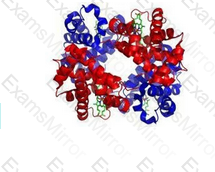
A normal hemoglobin molecule consists of a tetramer, of four heme and four globin chains, with a molecular weight of 64,500 daltons. Each of the four units can bind a molecule of oxygen for transport to the body's tissues. In the image shown below, there are four monomers (2 red globin chains and 2 blue globin chains) which form the entire hemoglobin tetramer structure. The green portions represent the 4 heme groups.
A normal hemoglobin molecule is comprised of the following:
Cryoglobulin testing can be used to:
Hives and rash usually indicate an allergic reaction. Hematuria is due to a variety of causes. Fever and chills usually indicate a febrile reaction. Positive DAT due to conditions other than sensitization to red cell alloantigens is not uncommon. Therefore a positive DAT in the posttransfusion specimen with a negative DAT in the pretransfusion specimen is more likely to indicate alloimmunization.
The most definite indication that a patient has been sensitized to a specific red cell antigen is:
Ferritin and hemosiderin are considered storage forms of iron.
Which substance(s) is/are considered iron storage compounds?
All of the following have been an inspection deficiency for CLIA-approved laboratories except:
The second choice is correct. Standard Precautions means to treat blood, all body fluids, all secretions (except sweat), all excretions, non-intact skin, and mucous membranes as if they were infectious. The purpose of this rule is to ensure the safety of and to protect those who come into contact with potentially infectious material.
Which one statement about Standard Precautions is most correct?

TOP CODES
Top selling exam codes in the certification world, popular, in demand and updated to help you pass on the first try.