
Halloween Sale Special Limited Time 75% Discount Offer - Ends in 0d 00h 00m 00s - Coupon code = drift75
Pass the ASCP MLT(ASCP) ASCP-MLT Questions and answers with ExamsMirror
Exam ASCP-MLT Premium Access
View all detail and faqs for the ASCP-MLT exam
841 Students Passed
87% Average Score
98% Same Questions
Kell, Kidd, and Duffy are usually warm reacting IgG antibodies. The most common P system antibody is anti-P1, which is a frequently naturally occurring low titer IgM antibody, seen in most P2 individuals.
Blood bank
Which of the following blood groups is most frequently associated with cold agglutinins:
Which of the following is NOT part of the stand or framework of the microscope?
Glycoprotein IIb/IIIa is integral in the process of platelet aggregation as well as clot retraction.
A defective clot retraction might be caused by which one of these?
The red blood cell distribution width (RDW) increases as the severity of alpha thalassemia increases because of changing MCV as the bone marrow produces smaller cells. In addition, if Hemoglobin H bodies are present, they result in the formation of schiztocytes (RBC fragments) that can have an effect on the MCV and RDW.
The Red cell Distribution Width (RDW) in alpha thalassemia is
Hemoglobin H is a tetramer made of four beta globin chains. Hemoglobin H occurs when there is very limited alpha chain availability used to make normal hemoglobin A. Hemoglobin H forms in those affected with alpha thalassemia major as well as in people with the combination of two-gene deletion alpha thalassemia and hemoglobin Constant Spring.
Hematology
Which of the following combination of globin chains comprise Hemoglobin H?
Molarity x Molecular Weight x Volume = Grams
Molecular Weight (aka Formula Weight) =
2(1) + 32 + 4(16) = 98
So, 4 x 98 x 0.2L = 78.4g
What weight of H2SO4 is contained in 200 ml of a 4 molar H2SO4 solution? (Atomic weight: H= 1; S = 32; 0 = 16)
The laboratory employee with an 2-year associate degree who performs clinical testing is the:
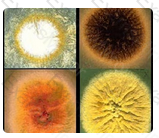
Micro - Matching
1. Upper left image
Multi-celled, rough walled macroconidia with a tapered terminal cell
2. Upper right image
Dense aggregates of echinulate, brown-black conidia
3. Lower left image
Loose clusters of elliptical conidia arranged in a "diphtheroid" pattern
4. Lower right image
Chains of large, lemon-shaped annelloconidia
Which of the following Rh antigens is found the highest frequency in the Caucasian population:
Shigella and Salmonella are not found as normal flora in the gastrointestinal tract.
Which of the following are not considered normal flora of the gastrointestinal tract:
If Kappa or Lambda is predominant and CD5 is co-expressed with CD19 (CD19/CD5 dual positive lymphocyte population), and CD23 is expressed, chronic lymphocytic leukemia is a probable diagnosis. CD19 is normally found on normal B cell populations and CD5 is normally found on mature T cell populations. However, CD5 is present on B cells in B-chronic lymphocytic leukemia or Mantle Cell Lymphoma, both abnormal B cell malignant processes.
CD23 expression is not consistent with Mantel cells as shown on the decision tree on the right.
A monoclonal B-cell population (Kappa or Lambda predominant) with expression of CD19, CD20, CD23, and co-expression of CD5 is consistent with which of the following?
Yellow stopper tubes are used for all of the following except:
Question options:
The MCV is indicative of microcytosis with MCV=<80fL. The RDW is within normal limits and indicative of a homogenous cell population.
If the MCV was >100 fL, this would be indicative of macrocytosis. An RDW that was outside of normal limits would be indicative of a heterogenous cell population.
An 18 year old female has a CBC as part of a routine physical exam. The following results were obtained and the physician determines she is anemic. After reviewing her CBC results shown below, which of the following would be an appropriate description of the anemia?
White blood cells (WBC): 5.6 x 10^9/L (RR:4.0-10.0 x 10^9/L)
Red blood cells (RBC): 3.7 x 10^12/L (RR: 4.2-5.9 x 10^12/L)
Hemoglobin: 9.9 g/dL (RR:12-16 g/dL)
Hematocrit: 28% (RR: 37-48%)
MCV: 75 fL (80-100 fL)
RDW-CV: 14% (RR: 11.0-15.0%)
Blood Bank; Immunology
Which of the following best describes the primary function of antibodies:
Antidiuretic hormone, or ADH, has the important role of conserving body water by reducing the loss of water in urine by changing the water permeability of the distal tubule and collecting duct. An increase in ADH causes a concentrated urine since the water is retained and absorbed through the permeable membrane. An decrease in ADH causes the collecting ducts to retain very little water, instead it is excreted as urine.
Chemistry
Which of the following action describes the MAJOR property of antidiuretic hormone?

TOP CODES
Top selling exam codes in the certification world, popular, in demand and updated to help you pass on the first try.