
Halloween Sale Special Limited Time 75% Discount Offer - Ends in 0d 00h 00m 00s - Coupon code = drift75
Pass the PRMIA PRM Certification 8011 Questions and answers with ExamsMirror
Exam 8011 Premium Access
View all detail and faqs for the 8011 exam
705 Students Passed
97% Average Score
94% Same Questions
Which of the following statements are true with respect to stress testing:
I. Stress testing results in a dollar estimate of losses
II. The results of stress testing can replace VaR as a measure of risk as they are better grounded in reality
III. Stress testing provides an estimate of losses at a desired level of confidence
IV. Stress testing based on factor shocks can allow modeling extreme events that have not occurred in the past
Which of the following is the best description of the spread premium puzzle:
Which of the following statements are true in relation to Historical Simulation VaR?
I. Historical Simulation VaR assumes returns are normally distributed but have fat tails
II. It uses full revaluation, as opposed to delta or delta-gamma approximations
III. A correlation matrix is constructed using historical scenarios
IV. It particularly suits new products that may not have a long time series of historical data available
Which of the following are valid objectives of a reverse stress test:
I. Ensure that a firm can survive for long enough after risks have materialized for it to either regainmarket confidence, restructure or be sold, or be closed down in an orderly manner,
II. Discover the vulnerabilities of the current business plan,
III. Better integrate business and capital planning,
IV. Create a 'zero-failure' environment at the systemic level in the financial sector
In setting confidence levels for VaR estimates for internal limit setting, it is generally desirable:
A risk analyst analyzing the positions for a proprietary trading desk determines that the combined annual variance of the desk's positions is 0.16. The value of the portfolio is $240m. What is the 10-day stand alone VaR in dollars for the desk at a confidence level of 95%? Assume 250 trading days in a year.
Which of the following best describes the concept of marginal VaR of an asset in a portfolio:
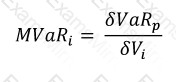 A mathematical equation with numbers and symbols
Description automatically generated
A mathematical equation with numbers and symbols
Description automatically generatedWhen modeling operational risk using separate distributions for loss frequency and loss severity, which of the following is true?
An assumption of normality when returns data have fat tails leads to:
I. underestimation of VaR at high confidence levels
II. overestimation of VaR at low confidence levels
III. overestimation of VaR at high confidence levels
IV. underestimation of VaR at low confidence levels
Which of the following is not an event of default covered in the ISDA Master Agreement?
I. failure to pay or deliver
II. credit support default
III. merger without assumption
IV. Bankruptcy

TOP CODES
Top selling exam codes in the certification world, popular, in demand and updated to help you pass on the first try.